Pongo mi pie desnudo en el umbral / Christian García Bello


Prisma (Past Presents Future), 2021, steel, mannequin, mirror, hammer, suitcases


Detail, Prisma (Past Presents Future), 2021, steel, mannequin, mirror, hammer, suitcases, detail

Installation view

Installation view

Installation view

Intermodular Habitat, 2021, 65 x 90 x 120 cm, steel, MDF, faucet, drain, miniature telescope

Intermodular Habitat, 2021, 65 x 90 x 120 cm, steel, MDF, faucet, drain, miniature telescope, detail

Intermodular Habitat, 2021, 65 x 90 x 120 cm, steel, MDF, doorbell, laser cut gecko

Intermodular Habitat, 2021, 65 x 90 x 120 cm, steel, MDF, doorbell, laser cut gecko, detail

Intermodular Habitat, 2021, 65 x 90 x 120 cm, steel, MDF, sockets, bulbs

Intermodular Habitat, 2021, 65 x 90 x 120 cm, steel, MDF, sockets, bulbs, detail

Installation view

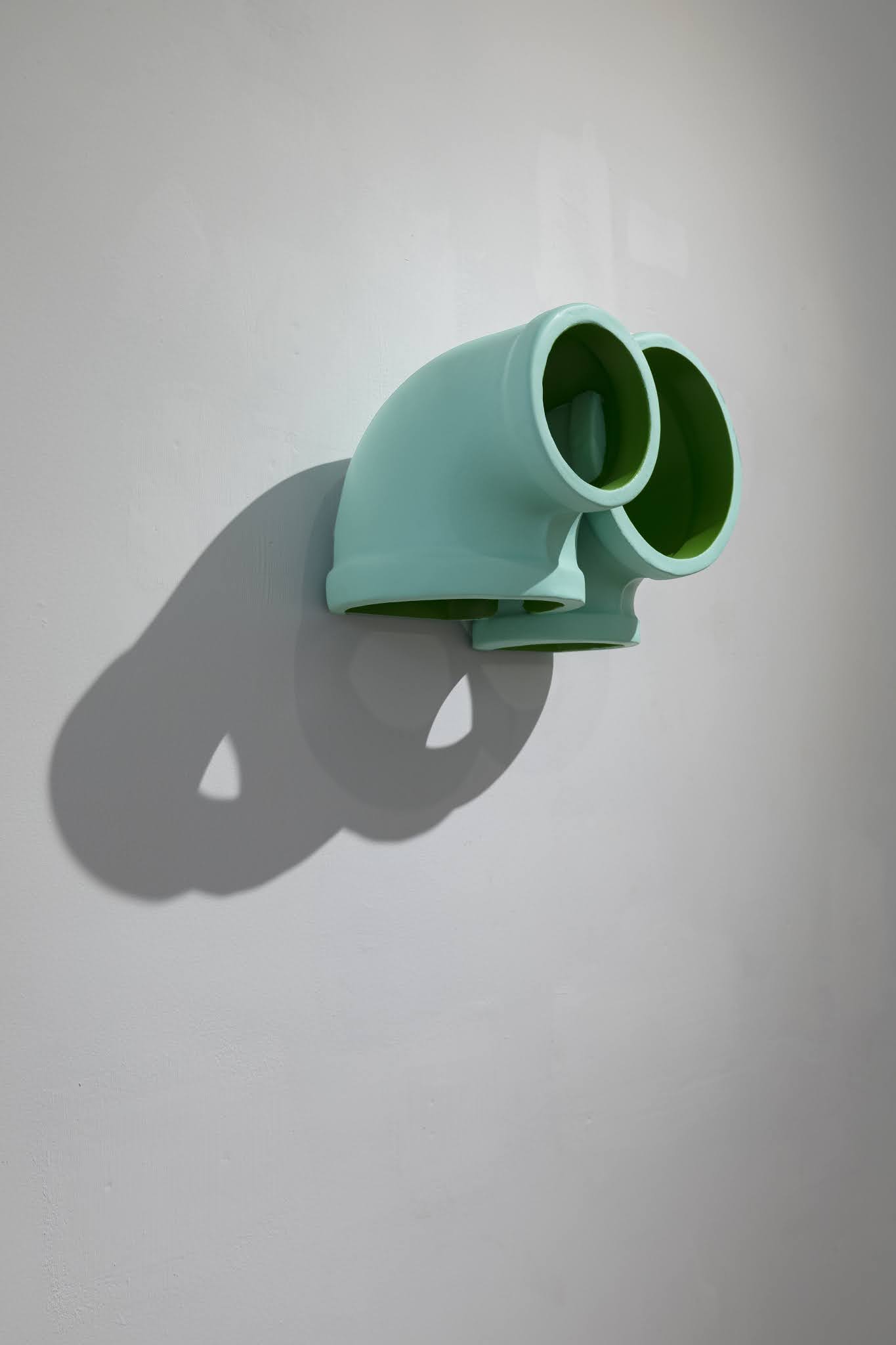
Pas Partu, 2021, 13 x 33 x 43 cm, laser cut catalog, epoxy resin

Installation view

Claustrum (Warped Model of Consciousness in the Cyber Space Age), 2021, 18 x 32 x 100 cm, steel, SLA
3D print

Retrograde (New Morning Star), 2021, dia 130 cm, lamp, locusts, epoxy resin

Retrograde (New Morning Star), 2021, dia 130 cm, lamp, locusts, epoxy resin

Installation view

Census, 2021, 50 x 65 cm, steel, glazed stoneware

Census, 2021, 50 x 65 cm, steel, glazed stoneware

Mask (Omni), 2021, 18 x 37 cm, glazed stoneware

Mask (Rhizome), 2021, 18 x 35 cm, glazed stoneware

Mask (Rhizome), 2021, 19 x 33 cm, glazed stoneware

Mask (Alter) 2021, 16 x 34 cm, glazed stoneware

Mask (Screen), 2021, 18 x 34 cm, glazed stoneware

Mask (Rhizome), 2021, 20 x 30 cm, glazed stoneware

Mask (Void), 2021, 19 x 35 cm, glazed stoneware

Mask (Xeno), 2021, 20 x 36 cm, glazed stoneware

Mask (Rhizome), 2021, 17 x 37 cm, glazed stoneware

Mask (Omni), 2021, 17 x 35 cm, glazed stoneware

“The Navy (feet on deck)”, n.d.
(1969-1972)

“The Navy (man lying on deck)”, n.d.
(1969-1972)

“The Navy (man under blanket)”, n.d.
(1969-1972)

Installation view

“The Navy (men on deck)”, n.d.
(1969-1972)

“The Navy (man in bunk)”, n.d.
(1969-1972)

“The Navy (man at table)”, n.d.
(1969-1972)

“Back of head”, n.d.

Installation view

Installation view

“The Piers (man sitting on
windowsill)”, n.d. (1975-1986)

Installation view

“The Piers (man wearing jockstrap)”,
n.d. (1975-1986)

“The Piers (man wearing jockstrap)”,
n.d. (1975-1986)

“The Piers (man wearing jockstrap)”,
n.d. (1975-1986)

“The Piers (man wearing jockstrap,
holding shorts)”, n.d. (1975-1986)

“The Piers (man wearing jockstrap,
holding shorts, walking)”, n.d.
(1975-1986)

Installation view

“The Piers (man wearing shorts)”,
n.d. (1975-1986)

“The Piers (man in jeans)”, n.d.
(1975-1984)

“The Piers (man undressing)”, n.d.
(1975-1986)

“The Piers (man undressing)”, n.d.
(1975-1986)

“The Piers (two men)”, n.d.
(1975-1986)

Installation view

Installation view

“The Piers (figure in hallway)”, n.d.
(1975-1986)

“The Piers (man on second level of
warehouse)”, n.d. (1975-1986)

Installation view

“The Piers (exterior with four
figures)”, n.d. (1975-1986)

“The Piers (exterior view)”, n.d.
(1975-1986)

“The Piers (exterior view)”, n.d.
(1975-1986)

p
“The Piers (exterior view with
figures)”, n.d. (1975-1986)

Installation view

“The Piers (man leaning)”, n.d.
(1975-1986)

“The Piers (Tava from back)”, n.d.
(1975-1986)

“The Piers (Tava from behind)”, n.d.
(1975-1986)

Installation view

“The Piers (man holding pants)”, n.d.
(1975-1986)
silver gelatin print
24.8 x 20.3 cm

“The Piers (man leaning)”, n.d.
(1975-1986)
silver gelatin print
17.1 x 11.4 cm

“The Piers (man going through
clothing)”, n.d. (1975-1986)
silver gelatin print
18.8 x 28.5 cm

“The Piers (man sitting, looking
down)”, n.d. (1975-1986)
silver gelatin print
23.8 x 19 cm

“The Piers (man sitting and
smoking)”, n.d. (1975-1986)
silver gelatin print
16.8 x 11.4 cm

Installation view

Instalation view

“The Piers (two men sitting)”, n.d.
(1975-1986)

“The Piers (warehouse interior)”, n.d.
(1975-1986)

“The Piers (warehouse interior)”, n.d.
(1975-1986)

Installation view

“The Piers (broken window)”, n.d.
(1975-1986)

Installation view

Installation view

“Mark”, n.d. (1975-1986)

“The Piers (man looking in window)”,
n.d. (1975-1986)

“The Piers (exterior view)”, n.d.
(1975-1986)

“The Piers (man lying in room)”, n.d.
(1975-1986)

Installation view

“The Piers (body under cloth)”, n.d.
(1975-1986)
silver gelatin print
11.4 x 16.8 cm

“The Piers (body under cloth,
umbrella)”, n.d. (1975-1986)

“The Piers (warehouse interior)”, n.d.
(1975-1986)

“The Piers (warehouse interior)”, n.d.
(1975-1986)

“The Piers (body under cloth)”, n.d.
(1975-1986)

Installation view

“The Piers (man seen through
window)”, n.d. (1975-1986)

“The Piers (group lying down)”, n.d.
(1975-1986)

“The Piers (two men squatting,
handjob)”, n.d. (1975-1986)

“The Piers (man in handcuffs)”, n.d.
(1975-1986)

“The Piers (three men on dock)”, n.d.
(1975-1986)

Installation view

“The Piers (man walking in
wreckage)”, n.d. (1975-1986)

“The Piers (collapsed warehouse)”,
n.d. (1975-1986)

“The Piers (smoking pier)”, n.d.
(1975-1986)

“The Piers (building collapsing)”, n.d.
(1975-1986)

“The Piers (warehouse and
demolition truck)”, n.d. (1975-1986)

Installation view

“The Piers (wreckage)”, n.d.
(1975-1986)

“The Piers (Hudson River)”, n.d.
(1975-1986)

“The Piers (man with two dogs,
looking across water)”, n.d.
(1975-1984)

Installion view

“World Trade Center at Night
(Westside Ghost)”, n.d. (1975-1986)

“Truck with motorcycle, elevated
west side highway”, n.d. (1975-1986)

“Pier façade with World Trade
Center”, n.d. (1975-1986)

“West Side Highway and pier
façade”, n.d. (1975-1986)

“Jimmy Carter”, 1976

Installion view

“The Piers (collapsed architecture)”,
n.d. (1975-1986)

“The Piers (collapsed architecture
with figure)”, n.d. (1975-1986)
silver gelatin print
image size: 11.7 x 18 cm
paper size: 20.1 x 25.3 cm

“Rick”, n.d. (1975-1986)

“The Piers (man with roller skates)”,
n.d. (1975-1986)

“Dog by water”, n.d.

Installation view

“The Piers (man sitting)”, n.d.
(1975-1986)

“The Piers (man sitting with leg
extended)”, n.d. (1975-1986)

“The Piers (portrait of young man
from behind)”, n.d. (1975-1986)

“The Piers (man from behind)”, n.d.
(1975-1986)

“The Piers (man sitting on ledge)”,
n.d. (1975-1986)

“The Piers (man from below)”, n.d.
(1975-1986)

“Cat on rocks”, n.d.

Alvin Baltrop
“Seated figure at The Cloisters”,
1965
Galerie Buchholz is proud to present an exhibition of photographs by Alvin Baltrop (1948-2004) at our Berlin gallery. Coinciding with Gallery Weekend Berlin, this exhibition is the second solo exhibition of the artist with Galerie Buchholz.
The gallery was first introduced to the work of Alvin Baltrop through the art historian and cultural critic Douglas Crimp (1944-2019). Crimp was instrumental in making Baltrop’s work more widely known through his writing and curating, beginning with his Artforum cover story for Baltrop in 2008, and then through the exhibitions “Mixed Use, Manhattan: Photography and Related Practices, 1970 – present” (curated with Lynne Cooke, Museo Nacional Centro de Arte Reina Sofía, Madrid, 2010) and “Greater New York” (MoMA PS1, 2015). The gallery’s first times exhibiting Baltrop were in the context of shows organized together with Crimp, first in Berlin (“Pictures, Before and After”, 2014) and then in New York (“Before Pictures: New York City, 1967-1977”, 2016). Crimp then introduced us to the Alvin Baltrop Trust, which is run by Randal Wilcox and Yona Backer of Third Streaming. In 2017 we presented our first Baltrop solo exhibition, which was curated by Douglas Crimp, and for which he also wrote an introductory text. In 2019 The Bronx Museum of the Arts presented the first comprehensive exhibition and catalogue of Alvin Baltrop, curated by Antonio Sergio Bessa.
The largest group of photographs left behind by Baltrop depict Manhattan’s dilapidated West Side Piers and the surrounding area from 1975 to 1986, when it was the city’s epicenter of gay social and sexual experimentation. Baltrop’s photography poetically documents the excitement and danger of this moment. This May, the Whitney Museum in New York is commemorating the history of this neighborhood through a new public art installation by David Hammons. Titled “Day’s End” in reference to Gordon Matta-Clark’s famous architectural interventions into Pier 52, which Baltrop photographed and which Crimp wrote about in his memoir “Before Pictures”, Hammons’s sculpture reconstructs the outline of the most notorious Pier. In tandem with the project’s realization, the Whitney presented “Around Day’s End: Downtown New York, 1970-1986”, an exhibition which featured artworks that relate to the pier, including works by Baltrop from the Whitney’s collection.
Alvin Baltrop’s posthumous legacy is indebted first and foremost to Randal Wilcox, an artist, friend of Baltrop in his lifetime, and a trustee of The Alvin Baltrop Trust. In 2012 he published a biographical text on Baltrop in the journal Atlántica. The below text is a selected adaptation of that text.
Alvin Jerome Baltrop was born in the Bronx, New York, on December 11, 1948, shortly after Dorothy Mae Baltrop, his mother, moved to the North from Virginia along with her oldest son, James. Alvin’s first exposure to art was James’s drawings; the younger Baltrop picked up a Yashica-C camera in order to respond to his older brother. Baltrop began his career as a teenager shooting on the streets of New York. Early on he also photographed the patrons of the Stonewall Inn, New York’s famous gay bar, to which he and other gay teenage friends gained entry by lying about their age, prior to the famous Stonewall Riots of 1969. The energy of this downtown community clearly had an effect on Baltrop, as he would later move to the East Village and live there for nearly three decades.
Unfortunately his mother, Dorothy Mae Baltrop, who was a devout Jehovah’s Witness and was often in conflict with Baltrop over his homosexuality, destroyed most of her son’s early photographs and negatives. One surviving print from this period is a photograph from 1965 [included in the present show], depicting a seated elderly woman reading a book at The Cloisters in Fort Tryon Park. This print anticipates many qualities that Baltrop would explore in his later photography. Baltrop frequently captured people engaged in looking or someone or something else. The act of viewing is therefore compounded and overlapping.
In 1969, Baltrop entered the US Navy, where he continued photographing at sea. He later recalled:
“I was just being sent to boot camp when they had the riots at Stonewall. My friends were sending clippings about it. We all used to hang out there, and now I was seeing my friends in the newspaper. I couldn’t tell anyone else about it, but after my first year in the Navy I learned that I could be a whole person… I was a medic. They called me W.D. – witch doctor. I built my developing trays out of medic trays in the sick bay; I built my own enlarger. I took notes about exposures, practiced techniques, and just kept going. I think I perfected my lighting skills there.”
In 1972, Baltrop received an honorable discharge from the Navy and returned to the Bronx. Following his brother’s example, he enrolled in the School of Visual Arts the following year on the G.I. Bill. In 1975, he began working as a taxi driver. As Weegee had done decades earlier, Baltrop used a police radio, which he hid in the vehicle, to locate crimes throughout the City that he could photograph during his breaks. It was during this time that he began to visit and take photographs at the West Side Piers.
In 1975, New York City was bankrupt. President Gerald Ford’s rejection of loan guarantees to the city was immortalized in the frontpage headline of the Daily News on October 30, 1975: “FORD TO CITY: DROP DEAD.” New York now had a vast supply of abandoned properties that it couldn’t even afford to tear down. The piers and their adjacent warehouses were adopted by New Yorkers for a variety of purposes. Some went there to sunbathe. Others went to engage in sexual activity. Teenage runaways, the homeless, and mentally ill went there because they had nowhere else to go. Thieves and murderes also went there looking for prey. An increasing number of artists also ventured there to make art.
Eventually, Baltrop quit his job as a taxi driver and purchased a van that he used in his new profession as a mover. Loading his van with cameras, film, food, wine, joints, and a handgun, Baltrop would stay at the piers for days on end, using his vehicle as a place to change clothes, eat, and sleep. In 1975, he dropped out of SVA because he could no longer juggle school, work, and his art. It was at this point that Baltrop fully committed to capturing the piers.
In 1986, the West Side Piers were finally demolished by the city, citing public health and safety concerns.
In the 1990s, Alvin Baltrop conducted interviews with people he knew from the piers to capture their memories of that time on tape. Two of these interviews are featured in the exhibition, with Rick and Mark, whose portraits by Baltrop are both in the show.
On the occasion of this exhibition, the renowned American science fiction author Samuel R. Delany, currently living in Philadelphia, wrote a new text, entitled “Looking Through Two Books of Alvin Baltrop’s with My Computer to Help”, reflecting on his time in New York and his memories of this specific area of the city. Delany has also written about this in his autobiographical books “The Motion of Light in Water” and “Dark Reflections”, as well as in “The Real Joe Dicostanzo”.
The photographs of Alvin Baltrop (1948-2004) were virtually unknown during the artist’s lifetime. A working-class African American, many of whose photographs are sexually explicit, Baltrop encountered only rejection. In the past decade his work has belatedly begun to be exhibited, including the Bronx Museum of the Arts, MoMA/PS1 in New York City, and Third Streaming in New York, the Reina Sofia in Madrid, and the Contemporary Art Museum, Houston. By far the largest cache of Baltrop’s extant photographs depicts the scene at the dilapidated Hudson River piers adjacent to Greenwich Village and the Meat Packing District. During the 1970s and into the 1980s, when Baltrop photographed there, the piers were a site of pleasure and danger for men seeking sex, sunbathing, making a provisional home, or just hanging out and taking in the splendor of the industrial ruins. More nefarious deeds also took place: theft, gay-bashing, even murder.
Baltrop claimed to be terrified of the place initially, but also intrigued; he began taking photographs, he said, as a voyeur. Eventually he became a denizen of the piers, at times living nearby in his moving van, which also provided his source of income. His rapport with certain of the pier’s users is clear enough in the straightforward portraits he made there, and is even clearer in photographs of men removing their clothes to pose for Baltrop. Some photographs are so intimate as to suggest that the sex they depict is staged for his camera – or, indeed, that photographing was part of the action.
Baltrop seems to have wanted above all to portray the environment in which these activities took place, the piers themselves. Sometimes you have to look closely even to locate people within the disintegrating remains of the pier sheds, much less see what they’re up to; and in any case they might simply be sitting on a window ledge or standing on a mooring. Or, more disquieting, they might be prone bodies covered with blankets, presumably sleeping. In many cases, there are no figures at all; Baltrop’s subject is simply the architecture in its vastness and melancholy.
Baltrop printed the majority of his photographs small, no more than 5 x 7 inches (approx. 13 x 18 cm), although he printed a few images considerably larger. There are variant sizes and crops of a few pictures. Because of the small size and density of information in many of the photographs, especially those of one pier taken from the distance of another, adjacent pier, you have to get very close to the picture to really see it. It has been noted that Baltrop’s pier photographs constitute a significant record of a lost era of New York industrial landscape and gay culture’s pre-AIDS history. There is truth in that view, but it suggests that Baltrop’s project was essentially documentary in nature, whereas the intimacy of the pictures, their studied compositions, their attention to the play of light and shadow testify to a wider ambition.
Douglas Crimp
Looking Through Two Books of Alvin Baltrop’s with My Computer to Help
by Samuel R. Delany
My firsthand knowledge of the docks and the sexual action that went on there under the highway and among the docks was about over when Alvin Baltrop’s photographs begin. One book, in which over 170 of his images are entombed, begins with Douglas Crimp’s observation, “In December 1973, a highway repair truck, laden with asphalt, crashed through the elevated West Side highway between Little West 12th St. and Gansevoort St., closing forever the section of the highway south of the collapse.” By that time, I had abandoned New York – and the kind of activity I wrote about both in The Motion of Light in Water, which took in many trips from east to west and hamburgers and coffee at the Silver Dollar 24-hour breakfast place on Christopher St., of which my meetings with Bill Stribling and Joe Soley were the most memorable, and a very uncharacteristic account in my memoir, The Real Joe Dicostanzo, which occurred shortly after the breakup of my music group Heavenly Breakfast and the murder of Martin Luther King on April 4th, 1968, by James Earl Ray. I doubt I ever stepped foot on or in Pier 52, but the kind of images Baltrop was able to spy on during daylight were commonplaces of the night under the highway during the 1960s. One picture of a particularly well-hung Scandinavian (page 143) brings back a comment made to me by the writer Judith Merril that particularly well-hung men have a certain cockiness to their walk. Myself, I was never particularly aware of it, nor is cocky the feel I take away from the photograph, but I do remember her saying it.
It takes texts such as Wojnarowicz’s Memories that Smell like Gasoline or my own Mad Man or Times Square Red/Blue to show those illicit moments Baltrop’s sometimes captured from a distance, sometimes from close up, and that white photographers such as David Hurle or my own fictive photographer Joe Salieri (in Dark Reflections) plumbed for the phallic profusion available during this or that passage of time, in that or this fragment of social space.
What strikes me most about Baltrop’s pictures is the comparative isolation of the subjects. Probably that is a factor of the fact that it was day.
The city locations are insistently marginal.
The sense of ruin is both romantic and oppressive and throws one back to the 18th century when, in Europe, after the Franco-Prussian war, the ruin itself became a symbol of romance. The etymology of a word like “pornographic” is both troubling and problematic: the writing of and by prostitutes. In a society such as ours, there are often men who feel that the exchange of money takes the focus off desire per se. An old adage that I first heard while I was still a teenager returns to mind: “Today’s rough trade is tomorrow’s competition” – not that I particularly found it to be true. In the case of most of Baltrop’s photographs, one is not sure whether these are people who have been caught in the act, who don’t care if they were caught in the act or not, or were caught just before or just after an act that may be as simple as removing one’s clothes for a sunbath; a few, however, suggest that a moment of commercial exchange is what the photographer’s attention and lens have fallen on.
The nude or the naked offers – in various climates – an entire sartorial critique that, again, goes back to William Blake and his wife sunbathing nude in their gardens, not to mention the somewhat notorious nudism of the great 20th-century-short-story master, Theodore Sturgeon.
Eventually, color takes over for a brief while, between pages 201 and 217, in the larger Baltrop volume, and at much the same time, a viewer paging through becomes far more aware of death and cats . . .
All such collections as they are framed in a gallery or in a book, accompanied by more or less informed, more or less accurate texts, are also being tamed: their separation from the place and time they were taken is being emphasized. There is little way to escape it. Baltrop died at age 55 from cancer; often we see him with the coffin nail between his fingers that took my own father at age 54, when I was nineteen. Page 11 of The Life and Times of Alvin Baltrop shows a foreshortened picture of the dockside bar Badlands I was in perhaps once under that name on a Gay Pride Day – which one I don’t remember – but, years before in the ’60s, when it was known as Dirty Dick’s, I wrote about it in some detail. By the time Baltrop photographed it, it was up from a place called The Ram Rod, whose sign is visible in his photograph. When I was there, there was another bar, I believe, called Hudson’s (but I may have it wrong), which was across the street, in which the photographer is pretty clearly standing for the picture I’m talking about. It catered to S&M (that’s three syllables) and did not particularly interest me in the Dirty Dick’s days.
Eventually, Dirty Dick’s/Badlands ceased to be a bar altogether and became a peepshow venue and which, as of 2019, was still standing with a “Store for Lease” sign on it, according to Google Maps. Somehow, these continuities, whether captured by a Baltrop photo or a glance out the window when being driven down West Street on some trip to the city or even a glimpse this morning in Google Maps, are reassuring in some way through their continuity.
Philadelphia, PA, April 12, 2021
¹By comparison with Baltrop’s work, the Peter Hujar photo of a day-time moment on the piers (p 56) looks incredibly coy, in a way it would not if the two central figures were simply naked.


Weltaneignung (World Appropriation)
We have essentially overtaken everything. Everything is “post”—that is, already
afterward. Post-internet, post-capitalism, post-modernism. Were we too slow? Are
we only able to face a world that we think is spinning faster and faster by becoming
faster and faster ourselves? By processing things even more efficiently and
rigorously? Only by growing can we survive, cries the unfettered neoliberal market
that surrounds us. “If acceleration is the problem, then resonance may be the
solution,” proclaims Hartmut Rosa, however, in his book Resonance—A Sociology of
our Relationship to the World. He postulates the hypothesis that “an aimless and
interminable compulsion to increase […] ultimately leads to a problematic, even
pathological relationship to the world […].”[1] For where should we position ourselves once we realize that higher, faster, and further are no longer attractive categories? The artists Lotta Bartoschewski and Sophia Domagala explore Hartmut Rosa’s concept of “world appropriation” in their exhibition of the same name, Weltaneignung. After all, every work of art is always an attempt to situate ourselves
in the world and to determine the exact coordinates between which we operate. At the same time, we appropriate the world through art, through the fact that we are producing something, and evade this aforementioned urge for more—because the things that are being produced here are not subject to any market-inherent logic. Lotta Bartoschewski often uses objects that are not only unconstrained by any market-inherent logic, but also those that we would otherwise reject: one-cent coins
that we have been collecting forever, only to never get round to taking them to the bank, old newspapers with yesterday’s news.
Here in Hanover, an isosceles triangle seems to float above the ground. It invites
visitors to react to it—makes them, even. Because the triangle is placed in the
middle of the space, they have to respond to it: Do they walk around it? Do they step
over it? This narrative opens up a reciprocal game between body and space. The
surfaces of the plaster sculptures, made especially for the space, reveal the negative
imprints of the molds, whose interior Bartoschewski painted and lined. The plaster
records everything, accurately reproducing all the information fed to it previously.
What is then depicted in the plaster is the mirrored trace of human activity. Every
fingerprint, every fiber is visible. One-cent coins are gathered on the structure like
jewelry; through the images imprinted on the coins, they tell their own stories of the
circulation of value and the meanings attributed to them. Another sculpture, a
rectangular frame leaning in a recessed alcove, features imprints of newspaper
clippings. Their raison d’être is no longer drawn from the news they proclaim, but
from the fact that they can be used in a different way. They, too, are only
recognizable in their mirrored form due to the printing process. Bartoschewski places
them in a different context and gives them a new purpose, one that is no longer
linked to usefulness and efficiency.
Sophia Domagala’s striped paintings are positioned differently. They are an endless
sequence of repetitions and the same gestures, softened only by small
discontinuities. The line is the simplest and most universal form, yet also the greatest
and most radical challenge. For no freely painted line will ever be perfect; even the
attempt is doomed to fail. They act like a grid through which a window to the world
emerges. Something that frames the main action and offers it a stage. The space in
between becomes an infinitely expandable resonating body. Domagala contemplates
each stripe thoroughly, like a word. While there was sometimes writing in her work in
the past, it has given way to stripes here, which now take on the task of
corresponding with the viewer. For isn’t writing ultimately stripes and lines strung
together? Domagala systematically explores the vertical line in various states: laid
over a newspaper clipping, as a wall painting, or on canvas. In each instance they
establish new spaces and enter into direct correspondence with the viewer. In each
stripe lies a new chance, a new attempt. All are the same yet each one is different.
While Bartoschewski’s work is established in the space and urges action in a
playfully inviting gesture, space is revealed in Domagala’s work through repetition.
The works of both artists function here as a resonance space in which we can relate
to the world. That is precisely why it is interesting to look at them together. If you
wanted to break it down, you could say: Bartoschewski works disruptively, Domagala
repetitively. According to Rosa, art “keeps your mind open to the fact […] that
another relationship to the world is possible.”[2 ]We thus learn the different ways in
which we can appropriate this world, how we can encounter it, and how we can enter
into correspondence with it. Without any acceleration, only the ability to immerse
ourselves in contemplation. Because when Nas asks, “Whose world is this?”, the
only correct answer is one that Rosa would also like: “The world is yours, the world is
yours—It’s mine, it’s mine, it’s mine.”[3]
Laura Helena Wurth: “Weltaneignung (World Appropriation)”, on occasion of the
exhibition
“Lotta Bartoschewski/ Sophia Domagala – WELTANEIGNUNG”, ad/ad – Project
Space, Hannover, 2021
Laura Helena Wurth is an author. She lives and works in Berlin.
[1] See Hartmut Rosa, “Resonanz—Eine Soziologie der Weltbeziehung” (Suhrkamp
Verlag: Berlin, 2016), p.14
[2] Rosa, “Resonanz”, p. 495
[3] See Nas, “The World Is Yours,” by Nasir Jones, Illmatic (Columbia, 1994), LP.
Text by Laura Helena Wurth
looking in to look out
Waèl Allouche, Vicente Baeza, Tash Keddy, Sam Marshall Lockyer, Rodrigo Red Sandoval
initiated by Àngels Miralda
16 – 27 June, 2021
PuntWG
WG Plein, Amsterdam


It hits you like a roaring crash. The first step taken beyond the dunes is met with topples and dives and collisions. It carries coarse sand particles that whip your cheeks and pounce like thick brown snakes towards their unsuspecting prey. An ecosystem of marine life, shells, algal blooms, oyster sperm, schools of fish and bleached driftwood enter through every cavity, hole, every porous element of exposed skin. A smell in the air, salt burns eyes and tastes dry on the inside of red glowing cheeks. Retreating from fierce elements behind a dune, a world appears. A patch of moss, mites, molecules, birth and death and everything that lies between. A shared moment is enough to create a community in this large mess called universe, galaxy, planet earth, island coast, a small area behind the shelter of a natural dune next to the windswept path leading to a quicksand reservoir, a tidal pool, a vast expanse.
The exhibiting artists came together in April 2021 during a visit to Texel island. The trip was not an official residency and therefore acts as a provocation to question traditional formats of residencies and communal experiences. A event on the 26th of June will be led by Hugo Palmar, organising member of airWG, in order to connect the recent programming of airWG, the current parallel exhibition initiated by resident artist Mire Lee, and the questions facing established organisations as we emerge from recent conditions. The works of the exhibiting artists are connected by an event rather than themes, but can be interpreted through topics of hosting, intimacy, scale, and the poetics of materiality.
https://daily-lazy.com/wp-content/uploads/2021/06/looking-in-to-look-out-at-puntwg-amsterdam-1-scaled.jpgHANG ON, WARTE!
Monika Brandmeier, Miguel Angel Fernandez, Miriam Jonas, Marion Orfila, Benedikt Terwiel, Johannes Tassilo Walter, Andrea Winkler, Michaela Zimmer
19.06. – 27.06.2021
Sat/Sun 2 – 8 pm and on request
SPOILER — Aktionsraum Moabit, Quitzowstraße 108a 10551 Berlin


https://daily-lazy.com/wp-content/uploads/2021/06/antonin-giroud-delorme-at-placement-produit-aubervilliers-1-scaled.jpg
PUBLIC Gallery is pleased to present Earth altar, the debut solo exhibition of Christian Quin Newell. Bringing together a new series of large-scale paintings, drawings and miniatures, the exhibition expands on Newell’s distinct iconography of archetypal images, transhistorical characters and multilayered plots within a sequence of dreamscapes.
Newell’s visual language draws on his own lived experience, as well as a myriad of references from art history, mysticism, alchemy and psychology, resulting in a personal mythology populated by an amalgamation of symbols and avatars. Anchored around a semi-autobiographical protagonist, the works in this exhibition contribute to Newell’s exploration into the multivalent facets of the ‘self’, revealing a cyclical journey into past, present and future lives.
Traversing time and space, the mutable image of the exhibition’s central figure appears throughout taking on a variety of forms and identities, both bodily and spiritual. In the miniatures and charcoal drawings we see stoic portraits of this character as an archetypal warrior or mystic, accompanied by a circular form evoking a sun with rays. This solar symbol is present in many of the works, acting as a window into the ‘self’ or gateway into other selves. In Memory Palace, a large scale diptych we see this shape surrounded by floating faces recalling Japanese Kabuki masks which appear in varying states of focus, alluding to the ‘persona’ or mask we present to society and our inner ‘shadow’ formed of repressed desires and animalistic instincts.
Newell’s interest in the multiple aspects of the ‘self’ or the existence of many selves is rooted in his study of Buddhism, tarot cards and the archetypal psychology developed by Carl Jung. Inspired by the universal dualities central to these subjects of interest, Newell’s main characters are often portrayed as the archetypal hero or anti-hero, yin and yang. In Chamber of Reflections they can be seen shrouded in both light and dark at the foot of the canvas, studying an ephemeral scene of archers practising the Ancient Japanese tradition of Kyudo, literally meaning ‘way of the bow’.
Considered a discipline that will lead to moral and spiritual advancement, Kyudo is central to Newell’s conception of the epic at hand, which sees its protagonist face a series of external and internal battles as they seek self-realization or enlightenment. This ritualistic practice, alongside many of the inspirations behind and concepts explored within his work, also links to Newell’s process of creation which engages practices of mindfulness and seated meditation to achieve ‘single-pointed concentration’––a level of focus that allows the materials or tools to work through him leading to a heightened awareness of the nuances in texture, colour, tone and light.
There is visual coherence to the overall group of works on view, both in their similar palettes and tones utilising underpainting techniques of the Venetian Renaissance, as well as in recurring characters and motifs, the striking use of light and illusory treatment of scale which often defies perspective alluding to different time zones or planes of existence. Ruminating on concepts of rebirth, karma, morality, and the act of storytelling itself, Newell’s work becomes a strategy of fantastical autobiography and a unique way of seeing––looking closely at both the external world and deeply within oneself.
Christian Quin Newell (b. 1991, Latisana, Italy) lives and works in London, UK. He holds a BA from Camberwell College of Arts, London, UK. Recent exhibitions include APOTHEOSIS, WT Foundation, Kyiv, Ukraine (2021) and 100 Drawings from Now, The Drawing Center, New York, USA (2020). He completed an invitational residency at the WT Foundation, Kyiv, Ukraine at the beginning of the year and was the artist in residence at The Fores Project, London, UK, May 2021.


PUBLIC Gallery is pleased to present Wasted Dreams, the debut UK solo exhibition of Italian, London based artist Guendalina Cerruti. Through an expansive installation that combines assemblage-based sculpture, LED art, mixed media wall and floor-based works, Cerruti explores the relationship between life, dreams and contemporaneity.
Influenced by domestic spaces, home decor, architecture and the urban landscape, Cerruti’s artmaking acts as a cathartic pursuit to process the world around her––both the interior world of emotion, thoughts, memories and the exterior world of popular culture and society. In this exhibition, Cerruti transforms the gallery space into a domestic interior blending London’s urban landscape with childhood bedrooms to ruminate on the notion of youthful aspirations––hopes that we had for our lives, but which have been forbidden, changed or faded away over time.
Within this nostalgic setting, Cerruti’s customised furniture forms a materialistic micro-universe reflective of stimuli that shapes our capitalist society and desires. Inspired by the streets of central London where one is constantly exposed to consumerist aspirations through street advertisements and wealthy neighbourhoods, we see a chest of drawers mutate into a regency style town house complete with parking space for luxury cars, while a rocking chair imitates a Porsche design boasting the eccentric colours and surfaces seen in sports cars that rev through the city.
Cerruti’s use of different decorating techniques to achieve a variety of textures within each piece evokes a range of visceral emotions and conceptual contexts. In contrast to the ostentatious display of monetary success so often equated with aspiration seen in the bright marble-esque painted townhouse and shiny sparkle induced sports cars, we see a wooden cradle transform into a London underground train coated in a layer of fake dirt and dust. For Cerruti, the old train covered in muck represents a more grounded setting of self-reflection––a collective resting place for the wasted dreams of its daily commuters.
In the center of the space, a monumental decoupage book evoking a teenage diary of dreams stands tall. Entitled Wasted Dreams, this work exemplifies the combination of youthful aspirations informed by both personal whims and society at large present throughout the exhibition. Tapping into the aesthetics, trends and lifestyle of new generations in which social media shapes so much of one’s goals and aspirations, the bright colourful pages full of glitter and confetti are layered with cut out images, from Justin Bieber to the sunset skyline of Los Angeles, symbolising the prevalent force of celebrity influencer culture in shaping our desires.
Part fictional, part autobiographical Cerruti’s installation brings together collections of narratives, micro-universes dense with sentiment, sarcasm and candour. Like the inhibited dreams of youth there is a sense of the fantastical throughout the works on display, where anything is possible, and nothing is quite as it seems.
Guendalina Cerruti (b. 1992, Milan, Italy) lives and works in London, UK. She holds an MA from the Royal College of Art, London, UK and BA from the Nuova Accademia di Belle Arti, Milan, Italy. Solo exhibitions include Love you, Bye, Studiolo, Milan, Italy (2018) and Guendalina, Studiolo, Milan, Italy (2015). She has participated in numerous group exhibitions including Old Friends, New Friends, Collective Ending HQ, London, UK (2020); Vivace, Balcony Gallery, Lisbon (2019); Playful Aggressions, Greengrassi, London, UK (2019); Il disegno politico Italiano, A Plus A, Venice, Italy (2018); That’s IT, MAMO, Museum of Modern Art, Bologna, Italy (2018).


Authority Incorporeal
curated by Adomas Narkevičius
artists: Juta Čeičytė; Flaka Haliti; Karol Radziszewski; Rachel McIntosh, Jaakko Pallasvuo, Miša Skalskis & Stephen Webb; Žilvinas Dobilas & Jonas Zagorskas; Virgilijus Šonta
5 June – 4 July 2021
Rupert
Vaidilutes g. 79
Vilnius 10100, Lithuania


Part of the Baltic Triennial 14, ‘Authority Incorporeal’ is an international group exhibition that focuses on several works of art that have, over recent decades, sensed and continue to think through the relationship between secular and spiritual agency, daily referred to as power, on other occasions, affect or empowerment. Stemming from the malleable region of Central Eastern Europe, they are markers of different traditions, social milieu and moments in time as much as they are particular forms of knowing that slip out of them. The corporeal, material or otherwise felt presence of all these artworks suggests how murky the inner workings and distinctions between ‘justified beliefs’, commonly called knowledge, and beliefs lacking such qualifications, can be. In art history, the art world, as much as politics more broadly, the figure and idea of authority, supposedly self-explanatory, are awkward to legitimise using reason alone. As such, they occupy the gap between ‘the imaginary’ – desiring, paranoid, hopeful – inclinations and ‘the factual’ – necessary, inevitable, accepted – convictions.
The artworks of Juta Čeičytė (Lithuania); Flaka Haliti (Kosovo/Germany); Karol Radziszewski (Poland); Rachel McIntosh (US/Finland), Jaakko Pallasvuo (Finland), Miša Skalskis (Lithuania) & Stephen Webb (US/Finland); Žilvinas Dobilas & Jonas Zagorskas (Lithuania); Virgilijus Šonta (Lithuania) dwell in this interstice, making their own particular addresses through form and colour, as well as what and how they elect to represent. They allude to the continual yet not entirely predictable relation between art histories of the region and wider geo- and socio-political processes. Dwelling between the power of belief and the jurisdiction of knowledge, their aesthetic structures reorder entrenched historical and social relationships without issuing orders, all with the soft authority of something that has simply been made and perseveres towards the future.
‘Authority Incorporeal’ intends not so much to once again call the factual into question or further haphazardly conflate the two realms but rather to acknowledge the existence of this subtle transitional space, between that which was and is quelled as ‘irrelevant fantasy’, ‘superstition’ or simply ‘bad art’, and that which was and is authorised as ‘the only viable reality’, joining what Eve Kosofsky Sedgwick called reparative work. Alongside the artworks themselves, the exhibition wonders: how can we address this authoritative forgetfulness, an ongoing psychosocial repression – at times our own, of unreasonable, untimely and otherwise illegitimate beliefs, ideas and lifeworlds?
Never entirely incorporeal and absent, nor fully incorporated, the apparition of authority punctuates past and present in its new temporary embodiments – poking fun at us or itself looking silly in the process. In this particular locality, a magisterial apparition in its latest form tells tales of the young who do not remember; who, thus, now live in a way that is ‘healthy’, ‘wholesome’ and entirely ‘Western’. If this holds true, they, as it were, gave up the ghost. However, as Flaka Haliti’s artwork ‘Concerned by the ghost without being bothered’, which welcomes visitors suggests, a certain retention – being okay to feel things that are not entirely okay – in time might be more emancipatory than forgetfulness.


We violate the command and law that we bore audiences to death in rituals of circumlocution and propose to break all the taboos of our age by sinning as much as possible. There will be blood, shame, pain and ecstasy, the likes of which no one has yet imagined. None shall emerge unscathed. Since there is no afterlife, the only hell is the hell of praying, obeying laws, and debasing yourself before authority figures, the only heaven is the heaven of sin, being rebellious, having fun, fucking, learning new things and breaking as many rules as you can. This act of courage is known as transgression. We propose transformation through transgression – to convert, transfigure and transmute into a higher plane of existence in order to approach freedom in a world full of unknowing slaves.1
Goswell Road is proud to present the first solo exhibition of filmmaker Nick Zedd in Paris. Zedd is a self-exiled underground phenomenon, living in Mexico City since 2011, after selling his archives to Fales Library NYU for their ‘Downtown Collection’ and quitting New York – citing the end of counterculture due to market forces – the city he had called home since 1976.
Our movement achieved pariah status by virtue of our unrelenting attacks on dominant culture using the cheapest available tools. We proved that amateurs have more integrity than professionals and those who ape technical proficiency at the expense of authenticity show what pussies they are. That still pisses off a lot of people. Our work is exploitable to future generations immersed in the big simulation that passes for life on this prison planet.2
A fierce defender of the amateur and the founder of the Cinema of Transgression movement, Zedd published and edited the Underground Film Bulletin from 1984 to 1990 writing under various pseudonyms and publishing the self-penned manifesto that defined the movement of loose-knit like-minded filmmakers and artists using shock value and black humour in their work, including Kembra Pfahler, Richard Kern, Tessa Hughes Freeland, Lung Leg and Lydia Lunch.
The exhibition features a selection of Zedd’s films including Police State (1987), Why do you Exist (1998), Go to Hell (1984) and highlights the epic War is Menstrual Envy (1992), one of his most challenging films, banned in several countries, in its entirety, the audio soundtracking the exhibition.
A lot of the time the censorship was self-imposed by the people who ran the shows. They were terrified to show genitals or something… People that are afraid to take chances – that bothers me… In Oslo, Norway, when we showed my films I always had to make sure there was an exit in the projection booth, so we could climb down the fire escape in case the cops came to bust us.3
Step inside the perpetual exit sign, a space outside of time and place.
Nick Zedd makes violent, perverted art films from Hell- he’s my kind of director!4
–
1 Extract from ‘The Cinema of Transgression Manifesto’, written by Nick Zedd (under the pseudonym Orion Jericho), Underground Film Bulletin #4, 1985
2 Critical essay by Nick Zedd, ‘The Underground Film Bulletin & The Cinema of Transgression’, Printed Matter, Inc. site (https://www.printedmatter.org/programs/critical-essays/16-the-underground-film-bulletin-the-cinema-of-transgression)
3 Nick Zedd, ‘AN INTERVIEW WITH NICK ZEDD’, ‘Deathtripping, The Cinema of Transgression’, Jack Sargeant, Creation Books, London, 1995
4 John Waters, 1997
–
Nick Zedd (born 1956) is an American filmmaker and author based in Mexico City.
Andrés Pereira Paz / Isabel (In the Warmi Pachakuti)


“Time & Life” / David Ostrowski, Magnus Frederik Clausen
28 May – 1 Aug, 2021
Spazio ORR
Via Cremona 115
Brescia, Italy

All of us have to learn how to invent our lives, make them up, imagine them.
Ursula K. Le Guin
It’s something unpredictable / But in the end it’s right / I hope you had the time of your life.
Green Day
At the end of first grade, my parents enrolled me in a four-week long summer camp in the Alps, not far from Brescia.
The camp was organised by the parish to which my great-aunt, a nun, was in those days attached. In suburban
Northern Italy, the church still plays a fundamental role in the community’s social life, with the “oratorio” acting as
the primus motus for a significant number of sports and cultural arrangements. Or, at least, this is how I remember it
from my childhood.
Praying hour was scheduled each morning after breakfast and each afternoon before supper. The evening session
was the hardest, as it came after a long day out in the woods, usually spent on hikes that, in my memory, were
incredibly lengthy and physically exhausting. Once, we got caught by a hail storm on our way back, and we had to
run towards our refuge while pellets the size of ping-pong balls made the mountain slope so slippery, that we all got
home covered in mud.
The priest in charge of the colony was a towering man, with a thick reddish beard and a deep voice, wearing cargo
shorts in all weather conditions. His ribbed socks were a bright kind of light blue, and I soon realised that I could use
them to force myself to remain focussed, or even awake, while saying the rosary. Every time the verse “Our Father,
who art in heaven” came, I stared at them and imagined the priest as God, chilling in an infinite sky tinted with the
exact same shade of his knee-highs.
On my return, my grandma was curious to hear about my adventures. Was the food good? Were my fellows nice?
Had I learned something new? “Yes, I did!”, I shrieked with enthusiasm. I still recall her expression – a mix of terror
and entertainment – while she listened to me proudly singing a number of dirty rhymes, one after another, in a slang
between the Italian language and the Lombard dialect. The other kids used to sing them in the darkness of the
dormitory after bedtime or in the back seats of the tourist bus that would drive us to more distant destinations.
Her embarrassed chuckle and firm invitation to stop made me understand that something was wrong, but I wasn’t
provided with any further explanation. Only some years later did I come to discern the half-hidden sexual references
in the content of what, at the time, I had learned by heart and with no comprehension whatsoever.
Paola Paleari
Carsten Becker & Willem Besselink / Continental Colors
28 May – 19 Jun 2021
HAUNT | Kluckstraße 23 A, 10785 Berlin


Continental ColorsThe gaze is turned westward: the colours of Los Angeles, where the exhibition will be on view in 2022, mix into the continental European climate. In the exhibition Continental Colors, Carsten Becker looks at the implications of the German colour collection RAL and the American hue Olive Drab. Willem Besselink investigates the imaginary colours mentioned in the literature of the “Golden State” California.For Renaissance artist Giorgio Vasari, colore was nothing without disegno, the concept. Becker’s and Besselink’s colours are based on the disegno of the civilizational: regulations, norms and systems. Both artists decontextualize colour from its historic, literary and emotional purpose, in search of the logics of these contexts. In their works, they make us experience how civilizational concepts interact with us.Becker researches the German DIN catalogue of industrial standards and the RAL colour collection that standardize machine parts, materials, and colours since 1917 and 1925, respectively. Seemingly aiming at economic efficiency only, both DIN and RAL did have a great impact on the two World Wars. In times of war, when resources are scarce, standard parts provide advantages in both production and time. Standardized colours, like Dunkelgelb (Dark yellow), introduced in the German armed forces in 1943, and Olive Drab, the camouflage colour of the U.S. Army, shaped the war. During World War II, soldiers disguised in this way were facing each other in the deserts of Northern Africa.In his series Romankleuren (Novel colours), Besselink processes colours mentioned in novels written and set in Los Angeles. He uses self-created sets of rules as vehicles to make them comprehensible and tangible, physically as well as visually. Thus, his drawings result into a coded network of coloured lines, whose angles change with each chapter. In his paintings Besselink translates the poetics of imaginary colours into quantifiable colour blocks. Finally, orange ribbons, derived from Karen Tei Yamashita’s novel Tropic of Orange (1997), span the exhibition space and superimpose the architectural system.Becker and Besselink take history and literature, extract the colours and dissect their symbolic power. By arranging the colours into new forms and media, they offer an immediate visual access to the exhibited works and their inherent systematics. Sensory impressions and contexts, otherwise hardly separate in our perception, can thus be confronted with each other: The upright cardan joint no longer seems just that, after the colour Reinorange (Pure orange) has been identified as the corps colour of the military police Feldjäger, and the standardization of parts as having military purpose. In Besselink’s drawing, the optimistic radiance of golden lines turns brittle as soon as we realize that Ben H. Wintersʼ underlying novel Golden State (2018) is about a dystopian surveillance state.Anika ReinekeTranslation: Guus Vreeburg
AEG (all energy gone)
Sara Rossi, Sarah Rosengarten, Maria Kremeti, Ivan Geddert, Burkhard Beschow and Felix Amerbacher
02.06. – 06.06.
Rathenau-Hallen, Oberschöneweide
Wilhelminenhofstraße 83-85, 12459 Berlin
Many thanks to +DEDE and Treptow-Ateliers for making Rathenau Halle accessible to us.


https://daily-lazy.com/wp-content/uploads/2021/06/athanasios-argianas-at-arch-athens-1.jpg
Elsa Salonen / Distilling the Essence of the Seas
4 June – 4 July 2021
Ama Gallery
Rikhardinkatu 1
00130 Helsinki
Finland
Photography by J. Salonen / J. Clark


Samuel Chochon / VMC
Curated by Margaux Bonopera
May 28th – June 23rd 2021
Atelier Myriam Boccara
86 rue de la Folie-Mericourt
75011 Paris


A CMV renews the air in a room by evacuating it to the outside. It is this same movement between inside and outside that articulates Samuel Chochon’s solo exhibition presented in Myriam Boccara’s studio.
The first instance of this movement is found in the very space of the project, visible from the glass façade of the studio overlooking the rue de la Folie Méricourt. The passer-by can thus distinguish some of the images present on the walls without being able to capture the entirety of the interior space. It is after having penetrated inside the exhibition, that one understands that the artist transformed the walls giving the impression that these last ones were dug and that it emerges from it these images to the varied formats.
Suspenseful if it is, thus transformed, the place of the exhibition becomes progressively a piece in its own right of the project.
For VMC, Samuel Chochon has chewed up his imagination and to understand its origin, its references and its construction it is necessary to look at the first drawing made by the artist which was the starting point of this exhibition project, Scene of domestic life, 2020. If the expression seems to recall Bergman’s series (1973), the scene that Samuel Chochon draws is that of a solitary episode. In this large drawing (3.10 x 1.50m), we see a man in his armchair, submerged in a liquid and vegetal world. The presence of a record player suggests that the individual is simply immersed in a state of auditory contemplation, which gives rise to the various images presented in the exhibition. When one knows that Samuel Chochon himself has realized the sound piece emanating from the large abstract sculptures, one can easily imagine the sensorial retranscription that he has operated through this character.
And this is how we find in all the drawings made in black and white a distortion of reality, a modification of perspectives and materials represented for the benefit of an aquatic, domestic, intimate and corporal imaginary. Here, the outside, it is the eyes of the visitors, your eyes, which try, by all the angles, turning in all the directions, to understand what the artist wanted to represent. For that, it would be enough without doubt only to listen to the piece that this last one realized specially for the occasion and to doubt, a few moments, of where is the inside and the outside, of the world and of our own body.
Margaux Bonopera
Oscar / Wood (or how I learned to grow)
Umeå Academy of Fine Arts
Konstnärligt campus, Östra Strandgatan 30 B
903 33
Umeå


Anetta Mona Chişa & Lucia Tkáčová / havoC, anaeMia, A tacticaL knoT, us
curated by Franz Thalmair and Gudrun Ratzinger
May 19 – June 25, 2021
Kunstraum Lakeside
Lakeside Science & Technology Park GmbH
Lakeside B02
9020 Klagenfurt
Austria


Rua Conde de São Joaquim, 332
São Paulo, Brazil
For the interviews, perfomance documentation, online view, and brochure, please visit: apexart.org/aidar.php


The Day Before the Fall. Exhibition view.

Bruna Kury, Scorpionics from the series Scorpionics, 2020.


Castiel Vitorino Brasileiro, Who are you to lay on my bed, 2020.


Lucyfer Eclipsa, Anamneses: Dreams Distortions, 2020.


Ana Raylander Mártis dos Anjos, so far, so close (A, B and C), 2020.


TRANSÄLIEN,TRANSVISION, 2020.


Vulcanica Pokaropa, Intercession, 2020.


The Day Before the Fall
“Travesti Spirituality is a catastrophe, a destruction. It’s what makes a tower fall, the cards of this collapse, the dusk emerging from the dust of debris and yet it will never be debris. We are not the rest of what was broken, but what has caused the break.”
– Castiel Vitorino Brasileiro¹
Soon, they will fall. Those who want to rule our bodies and imprison our imaginations, they will fall. Propelled inescapably into the abyss by their own destruction, it has never been so clear that this fall is just a matter of time. But how long can decay last? This exhibition is a site of rehearsal and speculation, gathering six new works that, by conjuring up worlds to come, accelerate the inevitable ruin of today’s structures.
Despite all featured artists recognizing themselves as travestis², the exhibition does not aspire to represent an identity or introduce a comprehensive translation of experiences. Instead, it emerges from the urgency to cultivate space for multiple and shifting existences to experiment and inhabit art strategically: sensing the cracks, holes, and routes within artistic production and reception. In this moment of transition, the artists articulate healthy possibilities of collectively inhabiting the unknown and unpredictable grounds of the future.
Unexpected openings arise from chance encounters which prompt a shifting in perception and a questioning of assumptions. Still, retaining evidence of those encounters is a struggle in a city obsessed with the new, immersed in the endless cacophony of demolition. To rescue what has been silenced, Ana Raylander Mártis dos Anjos’ project, so far, so close displays a set of three doors removed from the restroom of a downtown São Paulo bar. Symbols of a space rife with both harassment and intimacy, they intend to divide the public and the private, yet are saturated with signs that refute exactly what they stand for.
In her ongoing research, the artist explores the overlapping, non-linear layers of time scrawled in the anonymous messages that surface and fade away on these frontiers. Though the gentrification of this neighborhood brings with it familiar mechanisms of erasure, Mártis dos Anjos’ work reaffirms the resiliency of those crossings and their unavoidable traces—residues that appear familiar yet distant, absent and abundant, meaningful and incomprehensible.
Visibility is not a simple matter. Being looked at does not imply being seen, recognized, or accepted. In the deadliest country for trans people, where the average life expectancy is 35, a refusal to conform to gender norms means existing between invisibility and hypervisibility, where one is both silenced and surveilled. The same goes for anyone who is Black, Indigenous, or living in poverty. Their visibility often amounts to brutal images of oppression, functioning as an instrument of fear and further isolation. TRANSÄLIEN’s optical installation TRANSVISION departs from the power of belonging to contrast the national collapse with the prosperity of travestis.
Comprising a 3D canvas that shifts according to which of the two accompanying masks the viewer wears, TRANSVISION demonstrates that perception depends on the position from which one stands; better yet, it depends on the eyes one possesses. The function of the mask is not to hide its wearer. Instead, it’s an instrument of revelation that challenges the viewer’s impulse to categorize. Requiring the viewers to don a mask is also a reflection of the artist’s own existence: TRANSÄLIEN wears them regularly in an effort to liberate the popular imaginary from cisgender normativity, unveiling new aesthetic possibilities rooted in the comprehension that life is a process of continual transformation.
It’s a proposition that questions what might surface if our imaginations and bodies were freed from the unreachable and utterly tedious standards of appearance, behavior, and desire instilled in us since childhood. In their deviation from gendered expectations, trans bodies are often referred to as unnatural, or monstrous. In Anamnesis: Dream Distortions, Lucyfer Eclipsa investigates dreams and nightmares present in her childhood memories. Mixing soft and sharp materials, the artist explores the meanings of monstrosity by reexamining her own history. Converting traumas and wounds into prosthesis and extensions, she generates ambiguous creatures of a bio-political fantasy in which mutability and regeneration are to be celebrated. Though these ludic figures appear to be in a permanent state of metamorphosis, Eclipsa evokes the beauty of existing outside defined realms.
The narcissistic ideals that construct difference as pathology underpin a system that demonizes and yet exploits and consumes the “other.” In Bruna Kury’s work, the resistance against transphobic, racist and patriarchal violence is rooted in a commitment to her own vulnerability. Scorpionics features fabrications such as dildo-knives—objects that are simultaneously an ode to pleasure and a weapon for counterattack—a self-defense mechanism that deflects the castrating gaze and the objectification of dissident bodies.
The installation is accompanied by archival videos of performances in which Kury delves into the tensions between pleasure and power and their bodily implications, prompting reflections on gender-based violence, property, and care. Drawing on postporn³ practices complicated by her Latin-American transfeminist position, Kury reverses the passivity assigned to the feminine⁴ and confronts the desire to control disobedient bodies that fuels current genocidal politics, such as the dismantlement of public health systems, mass incarceration, incitement to hatred, and police violence.
Castiel Vitorino Brasileiro, whose work also builds on care and life-affirming practices, maps the body in order to comprehend its sources of power. Grounded in this knowledge, the artist seeks to nurture reserves of creativity, sensuality, and courage exhausted by colonial violence so that Black and trans people can experience freedom and healing. Who are you to lay on my bed is a performative installation in which earth, crystals, and herbs are arrayed around a mattress, imprinted with a picture of the artist in a ritual of cleansing and balancing of the first (root) chakra, the focal point that grounds the body.
Who are you to lay on my bed is a fragment of a song sung to pombas giras: strong, astute and sensual feminine spiritual entities who lived defiant lives. Working through macumbaria,⁵ the artist penetrates into the invisible to understand how to fertilize the territories of existence. Exploring deep sources of energy, ephemeral places of chaos and clarity, fear and courage, the artist mobilizes ancestral wisdom to process the poisons of a sickened society.
As cultural theorist Gloria Anzaldúa notes, humans are taught to fear the supernatural: both the undivine, animal impulses such as sexuality and the unconscious, and the divine, the god in us.⁶ In Intercession, Vulcanica Pokaropa draws on her decade-long experience as a Christian to assemble an altar of sanctified travestis, not only acknowledging their inherent dignity, but affirming that theirs is a sacred community.
Mixing elements from Catholicism and symbols associated with the universe of travestis—such as razor blades, high heels and syringes—the altar unifies the profane and the divine into one single entity. By doing so, Pokaropa sacralizes historically-erased ancestors whose legacy forms the possibilities of the present and deposits faith on the future of dissident existences. Connecting temporalities, the artist recognizes how devotion forges promise, but inverts the racist principle that designates white men as the savior. According to Pokaropa, a future in Brazil disconnected from Christianity is unlikely, but if Jesus would come back today, it would be as a Black travesti.
The six installations build meanings intersected by the poetics of interdependence, appropriation and metamorphosis, intertwined by a collective struggle that shifts the structures, relations, and affects of power. It’s an open question whether this city—its fences and gates, empty buildings and ever-growing homeless population—can ever shape-shift into a place that, instead of obstructing, facilitates alliances such as those, especially when alliances necessitate the sharing of risks, resources, and a common ground.
While violence is a force of enclosure and constraint, resistance is an unfolding energy of openness, movement, and creation. Change is inevitable. By recognizing the potency gathered in this exhibition, we understand not only the proximity of the fall, but also how it announces the arrival of another time: one that does not proceed ahead, in the linear fashion of unceasing progress, but a future that shifts under, above, around, inside and before this one, a future that will certainly be the time of travestis.
Our enemies say: The fight has ended.
But we say: It has begun.
Our enemies say: The truth has been crushed.
But we say: We still know it.
Our enemies say: Even if the truth were still known,
It can no longer be spread.
But we still spread it.
It is the eve of the battle.
It is the forge of our squad.
It is the study of the battle plan.
It is the day before the fall
Of our enemies.
– Bertolt Brecht
Clarissa Aidar © apexart 2021
The Day Before the Fall is an apexart Open Call Exhibition.
Footnotes
1. Castiel Vitorino Brasileiro, “Exú Tranca Rua das Almas,” Ehcho, 2020, bit.ly/3wjk5FU (Eng. Trans. for this publication by Clarissa Aidar).
2. A transfeminine gender identity rooted in Latin America. It carries implications of class struggle and marginalization, which often lead to compulsory sex work.
3. Postporn theory assembles different practices that challenge mainstream beauty, desire, and filming aesthetics. It is centered on bodies that are marginalized and fetishized by the pornography industry and first originated in Annie Sprinkle and Veronica Vera’s Post Porn Modernist Manifesto, 1989.
4. See Jota Mombaça’s Towards a Gender Disobedient & Anti-Colonial Redistribution of Violence, (Down and Out Distro, 2019), Accessed March 18, 2020, https://downandoutdistro.noblogs.org/files/2019/05/Redistribution-violence-1-1.pdf.
5. Afro-Brazilian religious practices.
6. Gloria Anzaldúa, Borderlands / La Frontera: The New Mestiza (San Francisco: Aunt Lute, 1987).
7. Bertolt Brecht, “Unsere Feinde Sagen,” Gedichte 1926-1933, Frankfurt: Suhrkamp, 1990 (Eng. Trans. for this publication by Clarissa Aidar).
Vis a siV / Pas une Orange
4th May – 13th June 2021


Photo: L.A.L.D.
THE HOUSE
Jaana-Kristiina Alakoski,
Benni Bosetto, Reilly Davidson, Giulia Essyad, Adham Faramawy, Cleo
Fariselli, Chiara Fumai, Jason Gomez, Ellie Hunter, Uffe Isolotto
,
Gregory Kalliche, Lito Kattou,
Lucia Leuci
, Aniara Omann,
Catherine Parsonage, REPLICA (Simona Squadrito, Lisa Andreani, Chiara
C. Siravo), Giuliana Rosso, Namsal Siedlecki
, Oda Iselin
Sønderland, Federico Tosi and Bruno Zhu.
Only one person will be allowed
into the space at a time. The exhibition will be experienced in total
isolation. The gallery will have no staff and no physical interaction
is allowed. The exhibition experience is thus transformed: from an
otherwise ordinary social event to a private dimension in which the
vision becomes the space of self-reflection.
Monstrous, abnormal, deformed,
hybrid, supernatural; a sign sent by the gods, an omen – according to
Greek etymology (τέρας); warning (mŏnēre) and demonstration
(monstrāre) of desirable behaviour, in the Latin sense (monstrum),
but also prodigy, an exceptional fact happening and, in a sense,
standing out, as an exception, forcing people to question what is
otherwise ordinary.
In late antiquity and in the
Middle Ages, a monstrosity is no longer a prodigy; it becomes
associated with natural history, leaning towards the fantastic and
ending up, in our time, in the realm of horror and science fiction,
which outline the existence of alien and cyborg life forms. The
history of the word “monster” and of the constellation of
meanings that branches out from it through the succession of
historical eras up to our current era, in which, once its moral
undertone is accepted, we witness the “monsterrification” of
objects, individuals, groups, events. The idea of diversity generally
takes on a self-punishing value; bodies differing from the norm (or
normality), which, by deviating from impossible standards, set up
alternative ways in which corporeality presents itself, thus becoming
a violation of the norm. The prohibition becomes radical because it
is pervasive, crossing the fine line between the inherent antinomy
between a normal and an abnormal, monstrous, grotesque body. This
involves corporeality and physicality in their entirety, in the
present world, in the present era – in which an invisible,
parasitic microorganism becomes a threat to the survival of human
beings and makes any form of bodily interaction illegal, thus
radicalizing the measure of personal space and making the
contamination of such space an unavoidable pretext for punishment.
Body snatchers (The House)
is a super private, perhaps purely speculative and phenomenological
project, which leads the visitor into a bubble which is both familiar
and alien. In a scenario which is at once pre and post human, the
visitor finds him/herself surrounded by numerous, presumably human
(but no one can say for sure, no one can confirm it – if there’s
no one else to ask) bodily presences. Bodies, their representations,
their performances, their transformations, their fragmentations, and,
of course, their absence, piling up. Are these bodies too made up,
too dismembered, and distorted, to be human? Are these fragments too
elusive to be simply skin and flesh? The visitor will be forced to
see themself in other people’s “non-body”, in the trace left
after they cross their boundaries and become distorted, dismembered
and with multiple limbs, like real forms or materials, but improved,
like a disassembled and reassembled collective and personal self. A
restructuring of meaning is permeated by an outstanding pars
destruens, which, in
turn, imposes its own urgency. Looking away is not allowed, nor is
turning away: the other side has the same characteristics and the
same urgency. The possibility of staying uneasy is unwavering since,
perhaps, it is not the bodies on display which are monstrous or in
transformation, but rather it is the visitor’s body itself. The
more we forbid ourselves to conceive of hybrids, the more possible
their interbreeding becomes.
When bodies cross their own
boundaries, or parts are separated from the whole, they become
something disturbingly different. This forces the viewer to
renegotiate the boundaries between the inside and the outside,
between the bodies themselves – fragmented, “distorted” –
and the source of their own anxieties and fears. Thus, the uncanny
reveals its duplicity, just like an object which, while unknown and
maybe unknowable, unintelligible, and therefore deadly, is at the
same time somewhat familiar. The borderline between nature and the
unnatural reveals its fleeting and vague character, giving rise to a
disorienting effect when reading and interpreting what we perceive,
which amounts to a sense of discomfort towards a body which is it not
possible to immediately discern whether it is alive or dead, real or
ghost; a three-dimensional and anthropomorphic body, that is, which
questions the certainties reality’s categories and ambiguously
mixes the opposite concepts of life and death, which are otherwise
necessarily experienced as binary, together.
Body Snatchers (The House)
– to be understood as a single collective work / experience –
lines up together speculations on reality and fiction, on
subjectivation but also on intersubjectivity, hierarchy and becoming,
the encounter with otherness, the relationship (interaction) between
different components / materials / realities and the negotiation
between the private and the public, I and We, I and the Other (and,
if it still exists, the other-body). As in Abel Ferrara’s
homonymous film, it is difficult to state what is real: you or them –
your body or theirs (and again, us or them – our body or theirs)? The
human body embraces and welcomes the non-human, the otherness, within
itself, harboring it and determining a presence / absence of bodies
in the making, evolving or reacting to something new and unexpected,
thus giving rise to a metamorphosis.
Corporeity is seen as stemming
from the relationship between the body and the organic, where the
organism is both a vital component and a structure, both a normal and
a normative organization. The aesthetics rooted in the states of
change and hybridization, of permanent transition, implies a
rethinking of these aporias with a view to an awareness of the
arbitrariness of the purity claim, of the adherence to the rules of
nature aimed at expelling and condemning diversity, of non-conform,
of abnormality accused of anomaly.
According to Gestalt theory, the
ways through which visual perception operates proceed from a sort of
overview that allows grasping the entirety of what is perceived.
Secondly, the original “holistic” approach is transmuted towards
an analytic understanding of the perceived data, operating a sort of
scanning of the single elements that compose it. Since «It
is at the same time true that the world is what
we see
and that, nonetheless, we must learn to see it»,
it is necessary to decline in a perspective sense our gaze on what
surrounds us, learn to relativize, suspend judgment and,
contextually, sharpen the critical sense. The sleep of reason
generates monsters, in the same way that the torpor of emotionality
generates inhumanity.
Body parts and flesh cuts not
always identifiable force the viewer to a visceral encounter with
both familiar and alien objects. A human corpse is not abject in
itself, but the encounter with it can certainly generate aberration.
But also attraction. A recalibration of one’s relationship to the
object involves the body while trying to assess whether the foreign
object is a source of threat or fascination, perhaps both,
co-belonging elements of a toxic soup that engenders seduction and
carnal interest in disgust, dystopian fantasies of voyeurism and
violence, visceral and sculptural allusions, imagined narratives of
bodily invasions; the rampant grotesque, with elastic, deformed or
monstrous bodies. The possibility of metamorphosing one’s own flesh
and image – of permeating its thresholds – is both intoxicating
and anxiogenic.
Body Snatchers
is a boundary creature that wanders between the edges of everything
that is familiar and conventional. It is eager for transformation, an
open mouth that invites us to descend into other worlds, into a space
of new ideas and ethical riddles. A ripe ground for the rooting of
perversions that push the boundaries dismissing the limits of any
legitimacy, freeing narratives dealing with infection and altered
states. Life is a constant change; we are eating the world, the world
is eating us. We are all mortal. We are all human. We are all flesh.
We cannot escape our inclinations nor our flesh and blood, their
decay and putrefaction. The next generation may also evolve into
cyborgs,while still remaining blood, guts and excrement… contagious
and virulent…
Shit and light.
THE CHURCH
Ed Atkins, Petra Cortright,
Julie Grosche, Oliver Laric, Heather Phillipson, Laure Prouvost,
Bárbara Wagner & Benjamin de Burca, Jala Wahid.
Only one person will be allowed
into the church at a time. The exhibition will be experienced only in
total isolation. The church will have no staff and no physical
interaction shall be allowed. The exhibition experience is thus
transformed: from a social and mundane event to a private dimension
in which the vision becomes the space of self-reflection.
The projection of each video
shall follow a random playlist following the order of the Canonical
Hours of the Catholic Church; the hours dedicated to communal and
collective prayer.
The videos appear as visions, as
frescoes that come to life on the walls of the church, as candles lit
for a saint or as prayers. The projections work as large mirrors
through which the visitor can compare and reflect himself (as a
comparison, in the absence of any other human presence).
Body Snatchers (The Church)
takes place at a time when the rules of isolation and physical
distancing are in force, a radically self-reflective time in which
the body does not necessarily have to perform or materially manifest
itself to others – if not through or within an immaterial
dimension. The project becomes extra meaningful given the current
situation of social distancing and expansive digital communication.
As the longing for physical contact with all that’s left behind,
excluded from our intimate bubble, is growing, the confrontation with
flat images gets more painful. We just have to caress the screen and
accept the value of the non-material being.
The project is set within a space
intended to host the liturgical assembly, an aisle which commonly
hosts people who believe in the real existence of the body and blood
of Christ, but which now hosts a body forced to believe that the
others, their substance, and their physical presence still actually
exist. The church is also the place where the faithful believe that
the body (the incarnation of the Divine) is resurrected and returned
to life after death; a place of life and death, of passage between
the two, and of their mutual interchange.
In the Gospels, the empty tomb
and the resurrection are one and the same. Women and apostles never
see the resurrection as the reanimation of the dead body. They only
see the absence of the body and the apparitions in a new and
mysterious form, open to interpretations. It is the absence, the
emptiness, the substance of resurrection.
The dreamy, awaited, escaped and
untouchable body becomes the image of a reproduction which meets the
needs of desire. The lost body is really absent, loneliness becomes
the place of its abstract presence. So is abstraction itself nothing
but absence and pain or is it painful absence?
Waiting for others activates the
manipulation of the object of desire, giving it a body, a face, a
character, intentions, words, which almost never correspond to
reality. The object one waits for itself, the mass-centre of this
dynamic, can actually turn out to be nothing more than an imagined
object: what is this body if not the product of imagination? Isn’t it
an unreal, evanescent body you are actually waiting for? Is the
awaited body endowed with its own objectivity or is its image linked,
by its very nature, to the subjectivity of those who think it?
In a place whose very name
indicates the space dedicated to the community, the gatherings of the
faithful and the liturgical assembly, Body
snatchers (The Church)
speculates on the dimension of isolation, transformation,
presence/absence and on passing and crossing physical boundaries, as
well as on the concepts of nostalgia, loneliness, pain and grief.


dandelion menace est la première exposition monographique de Claude Eigan en France. Elle se déploie autour de présences végétales qui forment trois familles : les bouquets de poings, les boucliers-corolles, et les feuilles-pièges-à-loups, toutes liées à la figure centrale de la taraxacum, qui lui donne son titre. Communément appelée pissenlit en français, en hommage à ses capacités diurétiques, cette plante aux vertus dépuratives se nomme également dent-de-lion pour ses feuilles acérées et sa collerette jaune touffue. Les œuvres présentées chez Artemis Fontana tracent toutes, à leur manière, les coordonnées affectives de l’artiste. Les poings de ses ami·e·x·s et de ses proches composent les cornes d’abondance entrelacées de la série soft and stone and high, 2020, présences chimériques oscillant entrew le végétal et l’aquatique : tantôt plantes, tantôt sirènes. Les contours des pavés berlinois habitent la série under no kings, 2021, composée de pièces murales installées en formation défensive. Des lanières permettent de les porter au bras en brandissant des fleurs de lys blanches et mauves, disposées à l’envers dans un retournement de l’emblème royale et religieuse. Enfin, les coordonnées d’espaces de sociabilités LGBTQIA+ chers à l’artiste ornent les mâchoires rieuses des feuilles de pissenlit de la série pissed, 2021, aux côtés de slogans et de symboles communautaires.
Ici, les fleurs ont laissé leurs attitudes lascives et se sont acérées, prêtes à piquer, à défendre, à attaquer. Tout comme la stèle du code de Hammurabi consacrait l’adage “œil pour œil, dent pour dent” à Babylone, les œuvres de Claude Eigan s’approprient le célèbre “Bash Back!” des Pink Panthers Patrol : elles revendiquent la rage comme un espace politique, et travaillent le continuum de la menace, de la violence et de la rétribution à partir d’une position minoritaire. Ces fleurs de résilience viennent donner corps à un jardin d’auto-défense, où la dialectique entre la représentation de la violence et l’action violente se déploie comme les deux faces d’une labrys, cette hache à double tranchant utilisée par la civilisation Minoenne comme symbole religieux; historiquement associée aux amazones, elle fut adoptée dans les années 70 comme symbole par les mouvements féministes lesbiens.
La violence traîne autour de dandelion menace comme une menace feinte, résidant dans l’anticipation de sa mise en œuvre plutôt que dans son action. C’est cette menace désarmée et l’imminence d’un futur différent qui habite l’exposition de Claude Eigan. Du symbole solaire, royal, et masculin du lion, supposé honorer la plante lui ressemblant, Claude ne conserve rien, préférant les caractéristiques vivaces et urbaines du pissenlit : capable de pousser entre les fêlures du béton, les pavés des rues et au travers du goudron. Dans une perspective post-humaniste, l’exposition argue pour la définition de sujets politiques complexes, inclusifs et changeants, qui rendent compte de la vulnérabilité des corps, et appelle un futur où la rage, la violence et la colère ont lieu de pratiques culturelles historiques dont la nécessité s’est fanée.
Thomas Conchou
https://daily-lazy.com/wp-content/uploads/2021/06/claude-eigan-at-artemis-fontana-paris-1.jpg


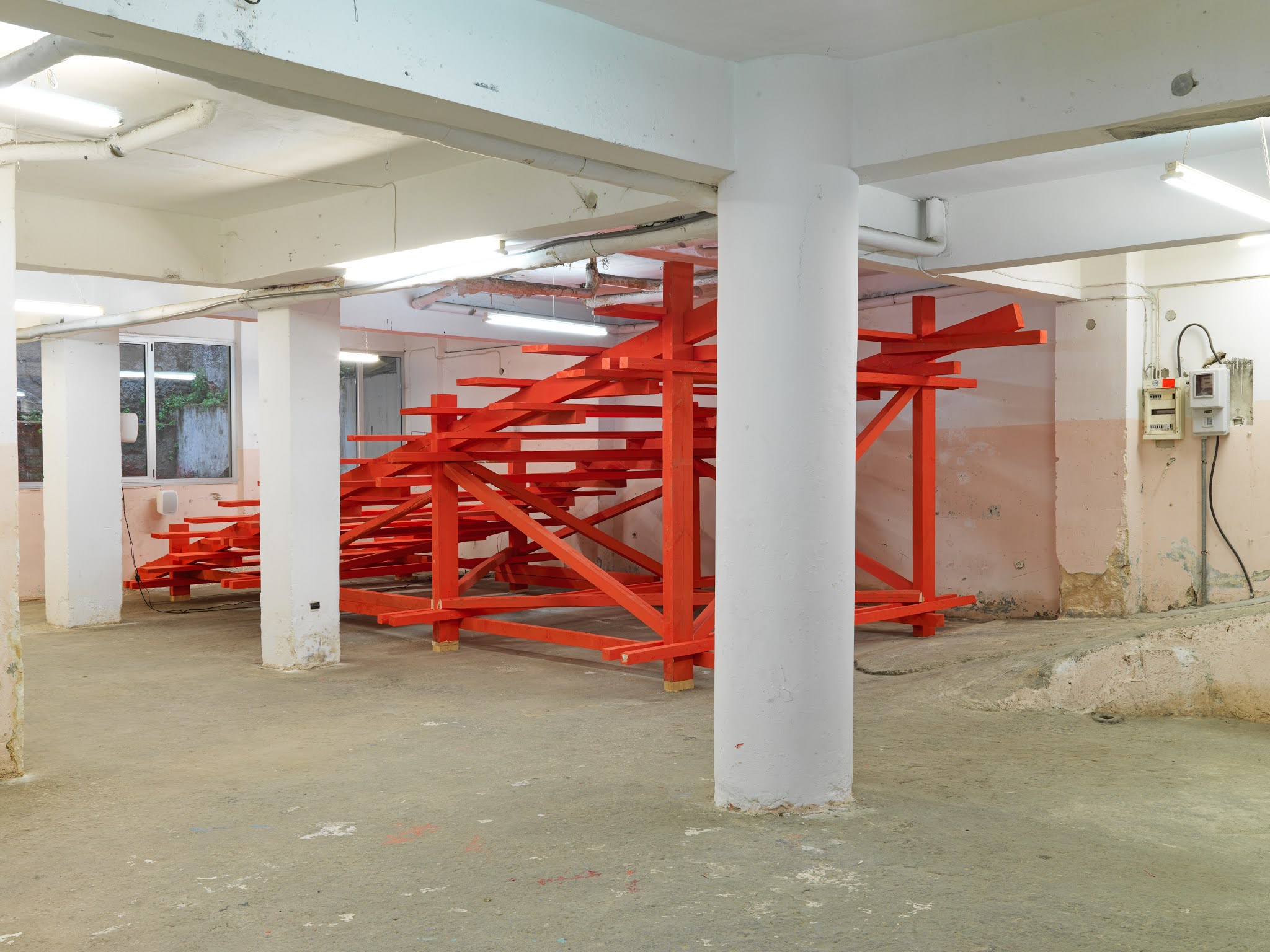


“A soft sonnet is all the strength I have” / Camilla Salvatore
26 May – 9 June, 2021
MASSIMO
Via Degli Scipioni 7
20129 Milan

Photo credit: Salvatore Pastore.
Images courtesy of the artist and MASSIMO
A soft sonnet is all the strength I have is the name Camilla Salvatore reserved for her first solo show, which will open on May 26th at MASSIMO Milanese space at via degli Scipioni 7. On this occasion, the artist presents Permanent Exile (2020), a newly produced video work that features an approach of installation that diverges from her cinematographic background.
“The guilt of predecessors burdens their offspring, oppressing it – as the Erinyes imposed the atonement of fathers to sons and their sons.” This way the artist introduces Permanent Exile. The artwork discloses the story of a young woman into WITSEC, constantly dealing with the attempt of balancing her psychological condition and the acceptance of her background. Seeking refuge into a fictional ambiance, which comes both as pure simulacrum and reflection of a more thorough, in-depth reality, is what she defines as an act of resistance. Floating into this hyper-uranium, she is struggling to survive her present times. The video unveils the woman through her absence, drawing both from her personal remembrance and her inner space through a sequence of images, shadows
and reflections that outline a disjointed portrait.
“I’d like to be faultless. In this delusion of mine, I would put myself on a pedestal of perfection, as a war machine”.
Through this statement, the work focuses all the attention on a self-examination path where thoughts, fears and concerns show up along the way. From here, the viewer can unlock the innermost, recondite side of the character’s mind.
In MASSIMO, the artwork gradually reveals itself to the viewer. The sound fills the space, welcoming him into the exhibition. Each video frame is reflected by the mirrored surface of prisms designed by Martina Taranto and placed in front of a projection screen hidden from view. These elements fluctuate between the visible and the invisible, and their material substance is dissolved, revealing the surrounding environment. The video stands out on a suspended panel, within a dark space that
highlights an intimate dimension of the fruition.
The intimacy behind the project resonates in the exhibition’s title: A soft sonnet is all the strength I have – incipit of a poetry by Amelia Rosselli – is the work Camilla Salvatore dedicates to the woman she pictures, as a grateful sign for having shared her story. This significant gesture brings to a conclusion a three years project that deeply marked both the women’s lives.
Permanent Exile has been produced thanks to the work of Giulio Scalisi, who created all the 3D animations, Germana Frattini, who supervised the creative direction and the archive footage, the sound designer Renato Grieco, the graphic and type designer Augusto Fabio Cerqua and the color
corrector Salvo Lucchese. Supported by Goldsmiths Moving Image and In Progress Milano Film
Network.
Camilla Salvatore
Born in 1993 in Torre del Greco (NA), she graduated in 2015 in Visual Arts at NABA, and attended a MA in Artists’ Film and Moving Image at Goldsmiths, University of London in 2019.
The short film Un Inferno (2016) was presented in competition at the Torino Film Festival and subsequently at the Trieste Film Festival. The film was also presented in the Premièrs Pas section of Visions du Réel, Nyon. 20 Settembre (2018) was presented in Filmmaker Festival’s Perspectives competition, where it won a special mention. Permanent Exile was developed in the Milano Film Network – MFN “In Progress” workshop, where it won first prize, and was presented in competition at Filmmaker Festival in 2020.
https://daily-lazy.com/wp-content/uploads/2021/06/camilla-salvatore-at-massimo-milan-1.pngKaterina Komianou
‘Heather stays at 505’
curated by Lydia Antoniou and George Bekirakis
27.05 – 30.05.21
Room 505 of
Perianth Hotel
Athens, Greece


“The atmosphere of the planet Uranus appears to be so heavy that the ferns there are creepers; the animals drag along, crushed by the weight of the gases. I want to mingle with these humiliated creatures which are always on their bellies. If metempsychosis should grant me a new dwelling place, I choose that forlorn planet, I inhabit it with the convicts of my race. Amidst hideous reptiles, I pursue an eternal, miserable death in the darkness where the leaves will be black, the waters of the marshes thick and cold. Sleep will be denied me. On the contrary, I recognize, with increasing lucidity, the unclean fraternity of the smiling alligators.”
— Jean Genet, The Thief’s Journal (1949)
Taking Genet’s depiction of another planet as a departure point of where we currently stand and how we move onwards, a room at Perianth Hotel constitutes a threshold space for our research. But yet what we yearn for is not Earthly. For smaller beings within an atmosphere, weightlessness lives alongside other unattainable fantasies of the absolute. The force of reason protectively anchors itself against the dwelling – a necessary tension, nearly erotic. Nearly as erotic as the stillness of the three bodies of Eros sculptures that move and change through their entangled surroundings. Same as when the fragments leave the studio and lying on the bed, overlooking the Acropolis. Hanging and lifted, they step from sublime to sublimation. Fragmented, detached but still full – suspended they are hanging on a pleasure-terror dissolve. In this relativity of a lucid dream state we invite the guests of 505 to wander and contribute to the growth of the fragments, prior to their confinement. In our pursuit of a not necessarily human atmosphere, we invite fragments of Katerina Komianou’s work and put her practice in conversation with our research. In her ongoing project, she is experimenting with bronze and moving image as part of her practice, approaching their materiality both sculpturally and metaphorically. The isolation of small floral fragments taken from the urban environment, found in the Athenian urban fabric with historical and political meaning constitute the entities that form the conversation and through that they are reformed themselves. This procedure produces reversals, giving birth to entangled fragments . For the four day event at Room 505 of Perianth hotel, we invite visitors to dwell among selected sculptural fragments of her work within a constructed habitual environment. Lie in bed with them and stare at the Acropolis as they are slipping, mystifying and eventually fading out with new fragments materialised through the conversations and entanglements that occur in room 505.
https://daily-lazy.com/wp-content/uploads/2021/06/katerina-komianou-at-perianth-hotel-athens-greece-1-scaled.jpg


Alicia Adamerovich
A Bat Out of Hell
Sans titre (2016) is pleased to present ‘A bat out of hell,’ Alicia Adamerovich’s first solo show at the gallery. For the artist it follows three months of residencies in Europe, first at Palazzo Monti (Brescia, Italy), then at Moly Sabata (Sablons, France), where she produced a new body of work composed of paintings, ceramics, drawings, and a new series of furniture-sculptures specially conceived for the Sans titre (2016) gallery space. The exhibition is conceived as the counterpart of a second show which will take place at Galerie Tator in Lyon from June 10th, 2021.
Inspired by the artistic trend of Biomorphism, Alicia Adamerovich’s practice studies the anthropomorphic nature of objects, sensations, and emotions, and highlights their creative potential. Her work takes form from her unconscious, from her interior thoughts and her psychic evolution. The artist divides her body of work into two distinct entities: “diurnal thoughts” and “nocturnal thoughts.” For ‘A bat out of hell’ at Sans titre (2016), the artist concentrated on the latter, that ones that appear when night falls and bats awaken. The figure of the bat – the only mammal in the world able to fly, which moves about only at night in a quick, lively, staccato manner – is omnipresent in the artist’s work. When it perceives a ray of light or when it encounters a conflict, the animal instinctively puts up its spurs to defend itself and injure the individual in front of it. In her work, Alicia Adamerovich depicts this precise moment when anguish surges in half-sleep. She develops forms both organic and animal. Some reveal a malign character; they seem to escape the frames and envelop us.
The artist’s graphite drawings and paintings represent a bridge between the real world and a fictional space. They’re intentionally produced in a portrait format, personifying the compositions. They express varied sentiments, such as fear, anguish, and perplexity. In the manner of her predecessors, like the couple Kay Sage and Yves Tanguy, who painted dream landscapes and underwater scenes populated with strange biomorphic forms, Alicia Adamerovich, in her works on paper, illustrates a certain tension within a phantasmagorical architecture situated within an infinite horizon. She creates a balance of power between these hybrid organisms stacked upon each other or surging to the front of the pictorial composition. They act as a projection of the US political situation in recent months; the artist retains a bitter memory thereof.
The handmade frames are for Alicia Adamerovich a way of leaving paper behind and exceeding drawing’s limitations in dimension. They reinforce the pictorial composition of the subject and play with hierarchies by conferring upon them the status of icons.
The furniture-sculptures that the artist conceived for the exhibition space were produced from bits of recycled wood, cut, sanded and dyed by her hands. The choice to use natural wood and the importance of demonstrating an artisanal craft are at the heart of the sculptor’s engagement. She confesses to having been fascinated as a youth by a neighbour in her village in Pennsylvania who had built all the furniture in his house by hand. The artist means to propose an alternative to industrial production. The link with Art Nouveau, a movement that arose in reaction to the massive industrialization of the end of the 19th century, is evident; Alicia Adamerovich also takes up its formal codes. The rounded curves of the furniture allow her to extend the limits of the physicality of the object into the surrounding space. They seem to become animate, like chimerical figures, and are at once functional, yet paradoxically endowed with a certain fragility.
—
Alicia Adamerovich (born in 1989 in Latrobe in Pennsylvania, USA) lives and works in Brooklyn, New York. She earned a BA in design at Pennsylvania State University and studied at the Maryland Institute College of Art in Baltimore. In 2018, Alicia Adamerovich won a scholarship from UrbanGlass (Brooklyn, NY). En 2021, the artist participated in residency programs at Palazzo Monti (Brescia, IT) and Moly Sabata (Sablons, FR), and in the coming months she will join the residency program at Del Vaz Projects in Los Angeles, CA.
Her work has been shown in solo exhibitions including ‘The Loner’s Castle’ at Projet Pangée (Montreal, ON); at Odd Ark Annex (Los Angeles, CA); ‘Vibrant Matter’ at the FISK gallery (Portland, OR). This year, she will show her work at Galerie Tator (Lyon, FR); at Palazzo Monti (Brescia, IT); at Del Vaz Projects (Los Angeles, CA); at Y2K Group (New York, NY); at Cob Gallery (London, UK). Alicia Adamerovich has participated in numerous group shows: ‘The Symbolists, The Flowers of Evil’ at Hesse Flatow (New York, NY); ‘Palazzo Monti: Transatlantico’ at Mana Contemporary (Jersey City, NJ); at the stands of Project Pangée at Art Toronto (Toronto, ON) and Material Art Fair (Mexico City, MX); ‘Tulips’ at Kapp Kapp (Philadelphia, PA); ‘A Fairly Secret Army’ at Wild Palms (Dusseldorf, DE); and ‘Serenity Later’ at Kunstraum (Brooklyn, NY).
https://daily-lazy.com/wp-content/uploads/2021/06/alicia-adamerovich-at-sans-titre-2016-paris-1-scaled.jpgIgnacio García Sánchez / Un sendero entre las ruinas
27th April – 17th July 2021


Hanna & Björn / Borta
29 May – 6 June 2021
Crum heaven
Högbergsgatan 38-40
118 26 Stockholm


Photography: Theo Christelis.


https://daily-lazy.com/wp-content/uploads/2021/06/bonjour-stockings-shoes-hairpins-at-artlacuna-london-1-scaled.jpg


All images courtesy and copyright of the artist and the space.
im labor is pleased to announce Yusuke Muroi’s solo exhibition, “Kodomo-Otona Clinic,” curated by mumei, Open on May 8, 2021.
About the Artist__
Yusuke Muroi (B.1990) is a Japanese artist who was born in Gunma, Japan.
He completed his MA from Tokyo University of the Arts.
In 2009, Muroi started to make work on the street, inspired by the graffiti culture. Along with graffiti, Muroi has always been interested in art brut and outsider art, and he began to collect things that seemingly exist between the inside and outside of art.
Also, Muroi is part of artist collectives “Issyuumawattetsurai,” which intends to turn unnecessary objects into artwork, and “Tofutokani Club,” which aims to produce one work a day.
His recent exhibitions include: “THEヨエロ寸-尋-,” VOU, (2021, Kyoto), “KEN & Peace” HIGURE 17-15cas(2019, Tokyo), “Hamster-Powered Night Light” mumei (2019, Tokyo), “Gunma Biennale for Young Artists” The Museum of Modern Art, Gunma (2017, Gunma), etc.
Anezka Grodzińska / Headquarters
curated by Jagna Domzalska


The headquarter carries a head within. It stands on it or rises touching the ceiling with it. It duplicates itself, forms groups and splits into delaminated layers. Inside the task allocation unit, its working strings and arrays construct their own architecture of feedback. The placement of the desks, their size and illumination determine hierarchical dependency.
In the article entitled The Line (dated May 1921) the artist writes: “The human is bored, considers work a dreary, tedious and futile spending of time, while their life—with minor exceptions—appears monotonous and void, for they fail to recognize in themselves an entity capable of constructing, building, and destroying.” Today, the building and the destroying have been taken over by corpostructures. Alone, there is little one can build or demolish. Only construction is left to the individual, most often available with “de-“ as a prefix, and no return options. Thus, we construct the shared space, the dependencies within its bounds above all. This is the sole thing we have access to as the material of resistance against that monotony of work.
Over the hundred years, various Offices for Brand Strategy and Sector Promotion have learned how to tighten the tolerances in the cogwheels of wringing the employee dry. The upper floors demand more, adding cubic or square metres in return. The promotion provided for in the structure invariably requires the material to be stretched yet again and further sections of time to be perforated. Here, the consciousness is moulded by the expanding space. This is the SelfDesk vs Helpdesk round being played.
The repression of vague forebodings we may have with regard to being penned in groups in the organized shared space exacerbates the tension and situational discomfort. Admiration and desires are awoken and aroused in the groups, only to die and expire because of them. We persist in the established pattern of behaviours, but grasp at every opportunity of release. We desire others, peeping at them through the apertures of the furniture and desks, simultaneously dreading the gaze of another resting on ourselves. The bonding connection is as forcible and impossible as it is yearned for and imagined.
Each and every office is a headquarter. The fact that the gallery is located in its immediate vicinity and the symbiotism of both spaces are not without significance. The installation Headquarters constructs itself by virtue of the material whose inherent properties dovetail with the analyzed issue. Built around a metaphor and reversed perspective, it compels one to look through to the other side. The successive openings and shapes create the interlacing weft of particular patterns. The dimensions are flattened in this world to maximize the communication and unequivocality of the guidelines. The target shape is discarded, leaving the blanking die in the inversion of what has been cut out. The hole offers a glimpse of the consecutive layers and couplings which strive to sustain the vicarious structure more or less intact.


Throughout his youth, Valentin Guillon was always on the move: spinning in circles in roller skating rinks, in gymnastics, and also in spirit. Today in his artistic practice, he seeks to rediscover such hypnotic perceptual experiences in which a state of great physical concentration leads to meditative spaces. In his studio, he draws circles, geometric forms, builds models of tracks, in a serial and surely obsessive manner. He follows a quest in which the position of the viewer is central as the works are addressed to their ambulatory gaze. The format of the canvas is intrinsic to a stage like protocol that puts the body, its possible trajectories, and the way it is included and excluded into play. Valentin Guillon’s work follows the same vein as that of El Lissitzky’s, who in 1927 proposed to manipulate sliding panels to vary the viewing points of artworks in his installation Cabinet des abstraits; or more recently Xavier Veilhan whose projects play with exhibition design by dynamically connecting the plinths, displays, exhibition labels, lighting, bodies and artworks, bringing invention to the exhibition space. Valentin Guillon also creates viewing devices, perceptive environments, and obstacles exploring different ways of leading the viewer to penetrate the spatial dimension of the artwork.
The painting is in situ: it designates the space and brings itself to the scale of the spaces it inhabits. The projects are formed through preliminary drawings and models which are used as steps to test, analyse and vary the proposals before entering the real space. Yet, at times the attention paid to the model portrays a sculptural or even pictorial dimension that stimulates the exhibition. Framed, hung, posed on a plinth, the model questions the necessity of the realisation by containing in itself an ensemble of possibilities open for the viewer to imagine.
Valentin Guillon has realised his second exhibition at the Galerie Florence Loewy as a reduced model of an exhibition that will take place in September 2021 at Wonder, a collective studio space in Clichy where he works. In it, we discover a fresco, a ring, tracks, and a net that crosses the room¬– a structure simultaneously connecting and separating the space. The forms that he manipulates evoke not only sport equipment and architecture inscribed in our collective memory, but also the history of geometric abstraction with the pleasure of misappropriation, play, and manipulation. By realising both projects at the same time, Valentin Guillon has created a tension. As in a tennis match, the gaze moves back and forth, from the model to the in situ work, skimming the net stretched between the two, never ceasing to put the work into play. The viewer finds themself stuck in a coming and going between two possible steps, experiencing the impossibility of deciding which one is complete. Valentin Guillon makes us live the rules that are at play on the field, as with his previous exhibition in the gallery where we literally stepped onto a roller skating rink. Here, we follow him in the time of preparation, the warm up, exploring his capacity to produce an aesthetic experience. In the narrow space of the gallery, Valentin Guillon multiples perspectives, optical movements, staging the path through a dense and stratified installation that warms the spirit and blurs the reference points between what makes an artwork and what makes an experience, an invitation to multiply the possible paths.
Mathilde Roman
Mathilde Roman is an art critic and she published «Habiter l’exposition. L’artiste et la scénographie» at Manuella editions.
Translated from the French by Katia Porro


the paintings, ex-tradition acts, 01-02 assemble comments from memoirs, news and social media platforms about a relative’s recent relief from US penitentiary facilities. These comments arise during the relative’s return to a country they had not resided in for twenty-seven years.
In the early months of the pandemic, I reflected on my relative’s and others’ continual experience with the prison industrial complex, as permeated through legal regimes. Some extradition treaties, for example, state that so long as the underlying conduct is criminal in both contracting states, it is irrelevant where the criminal acts were committed (art. 2, 3(b)). Even though extradition is not immune to the impact of the human rights branch of the law, I question whether human rights doctrines are sufficient; could these protections actually enable individuals and local communities from reconnecting and repairing harms on their own terms? To start my inquiry , I assembled a dialogue in the paintings as an attempt to place disparate voices in proximity to one another, since they are not able to share a space together.
The following text is a provision within an amended extradition treaty, that grants states judicial assistance in criminal matters on the basis of bilateral or multilateral treaties, or on an ad hoc basis. This would be the procedure my relative followed:
Article XV–Transit
Paragraph 1 gives each Party the power to authorize transit
through its territory of persons being surrendered to the other
Party by a third state.35 Requests for transit under this
article are to be transmitted through the diplomatic channel
and must contain a description of the person being transported
and a brief statement of the facts of the case upon which the
surrender is based.
—————————————————————-
35 A similar provision is present in all recent United States
extradition treaties.
—————————————————————-
Paragraph 2 requires that a Party shall respond promptly to
transit requests, but allows a Party to refuse permission for
transit if such transit would compromise its essential
interests.
Paragraph 3 states that no authorization is needed when air
transportation is being used and no landing is scheduled in the
territory of the other Part. If an unscheduled landing occurs
in the territory of a Party, that Party may require a request
as provided for in paragraph 1. In such a case, the person in
transit shall be kept in custody for up to 96 hours until a
request for transit and thereafter until transit is effected.
Bio
Andrew Freire is an artist working in installation, sound, and painting. His work participates within documentary practices, archive platforms and legal discourse. Research within these disciplines and subsequent artwork, allows him to reconsider the impacts of legal regimes, its generational transmission and mythologies. His current projects are exploring dynamics between resource extraction and memory. Freire earned a BA at the University of California, Los Angeles, and is a JD candidate at USC Gould School of Law.


All images courtesy and copyright of the artist and space.
What pleasure? The title of the exhibition indicates the identities and enables the association: Bernard Arnault, president of the LVMH group, Mark Zuckerberg, president of Facebook and Rihanna, pop singer and businesswoman, president of the Fenty brand. Formally, the display insists on the notion of sequence: that of structures, portraits and the black-red-blue color code. The reframings indicate the artist’s engagement with these images, mummified and sublimated icons, presented in icy placidity. Plasticized and chromatically coupled, the sequentiality acts out the rhythm of the dynamics of pleasure: it fixes the perception, directs the movements, provokes the desires.
How to get pleasure? In the epistemic model of the network, we cannot make clear distinctions between the types of agency of the works of art, the artists and the spectators. The only function of these actors is to perform the network, and their identity is thus given by their behavior. The backlighting of these images is maintained, refusing a compensatory effect of the exit of the digital. These images are avatars, and the users become by-products of their activity.
In Établissement d’en face, the repetition of structures, a hybrid mime of fair booths and tombs, forces the bodies to an inter-passivity that responds to the inter-mediality of the images. These entities do not possess their own reflection or rather, their reflection is diluted in the color code associated with them. Christophe de Rohan Chabot displaces the language strategies of these networks through a form of funeral rite.
Paolo Baggi


Gay Love in Pictures
 |


“Al limite del Visibile” / Francesco De Prezzo
6 May – 6 June, 2021
LOOM Gallery
Via Lazzaretto, 15
20124 Milan

At the Limits of Visibility are Francesco De Prezzo’s painted canvases, painted with care and then either
obliterated or covered with nearly transparent veils. Some of his subjects are entirely abstract, because
the final layer of paint is dense and opaque. Others are fully spelled out in their details, having escaped
the final brushstroke. In both cases, De Prezzo (Lecce, 1994) has studied the subjects with an eagle eye,
spending countless hours portraying the objects that surround him in his studio.
Fabrics, tripods, panels, containers, tiles, hangers and other objects that are used to cover, support,
contain or divide and that cast off their simplicity to enter a new dimension and acquire a new aura. What
we find in these works is an idea of synthesis and transformation away from figurative painting through
a process of layering and covering at the limit of the monochrome, questioning the possibility of fixed
visual perception and challenging the role of the image as language.
In Rosalind Krauss’s The Optical Unconscious – a rereading of modernism in which the critic questions
some of the idealist dogmas of traditional art history – one of the main themes is that of figure/ground
in relation to issues that fuel debate on the concept of “representation”. In De Prezzo’s work, figure
and ground switch places, the one going past the other: the image is supplanted and positions itself on
a different level. It is the same for his installations, where multiple subject/objects physically enter a
shadowy zone, modifying their utilitarian identity to become something else.
No figure, then, either; but a limit case of self-imbrication. The perceptual terms are rejected thus, and marked by this re–jection as not-figure and not-ground. But in being canceled they are also preserved. And the logic of that preservation is
made transparent by the graph. The graph’s circumference holds all its terms in mutual opposition: figure versus ground;
ground versus not-ground; not-ground versus not-figure; not-figure versus figure. Its diagonal axes yield, however, to mirror
relations, or rather to mirror restatements (the structuralists’ inverse-of-the-opposite, their double negatives), with figure
in this case being the “same” as not-ground.
Rosalind Krauss, The Optical Unconscious, 1993
Liu Fujie/ Three Exit Strategies
May 8 – June 6, 2021
Sense Space
No. 309, Ceramics 1st Street, 798 Art District
Beijing, China