
Market Art Fair
April 24 – 26, 2026, Stockholm
Magasin 9
Frihamnsgatan 66
115 66 Stockholm
Words by Koshik Zaman
This marks my 13th consecutive year attending Market Art Fair (in various capacities). I’ve been around long enough to have seen multiple shifts in leadership and venue over the years. As usual, the fair coincides with Stockholm Art Week, an initiative that has grown to involve so many institutions, artist-run spaces and initiatives, and galleries that it’s hard to keep track.
Though still predominantly Nordic, the fair continues to attract galleries from beyond the region, with this year’s exhibitor list including participants from the U.S. and the U.K. For its 20th anniversary, it has moved from what had almost become its near-permanent base to a warehouse, Magasin 9, in Frihamnen (the free port). Based on past experiences, venues outside the city centre tend to struggle to draw a local art crowd that is, let’s say, comfortable.
Approaching the site, the atmosphere feels different. The surrounding docks with cruise ships and towering silos rather than the green backdrop of Djurgården (the Royal National City Park), add to the experience – the sea, too, plays its part. Aesthetically and spatially, Magasin 9 is a departure from the iconic halls of Liljevalchs, recalling some of its international counterparts. Entering the space, perhaps it is the novelty, but the new venue marks a leap for the fair.
After an initial stroll, I get the sense that there is a slight emphasis on curated presentations, which is positive in an environment where sales are, of course, crucial, as the name itself suggests.

Marte Johnslien (floor) and Lisa Tan (wall), Galleri Riis, photo: Jean-Baptiste Béranger

Detail view: Lisa Tan, Galleri Riis, photo: Jean-Baptiste Béranger
Galleri Riis (NO), for instance, has a long-standing history of presenting curated exhibitions at the fair. Following last year’s two-person presentation with lens-based artist Eline Mugaas and local frontrunner Éva Mag, the Oslo-based gallery returns with a new and successful pairing: American-Swedish Lisa Tan alongside Norwegian Marte Johnslien. While working in different media, they are connected not only by a similar palette but also by a sense of shared symbolism, with Johnslien’s sculptures in glazed ceramics and compressed scrap metal feeling like an extension of Tan’s framed works – prints depicting illustrations derived from Swedish and Norwegian dictionaries – presented as part of a wallpaper installation.

Mirja Bozarth Fornell, Nathalie Djurberg & Hans Berg, Sally J. Han, Isabella Ducrot, Belenius, photo: Jean-Baptiste Béranger
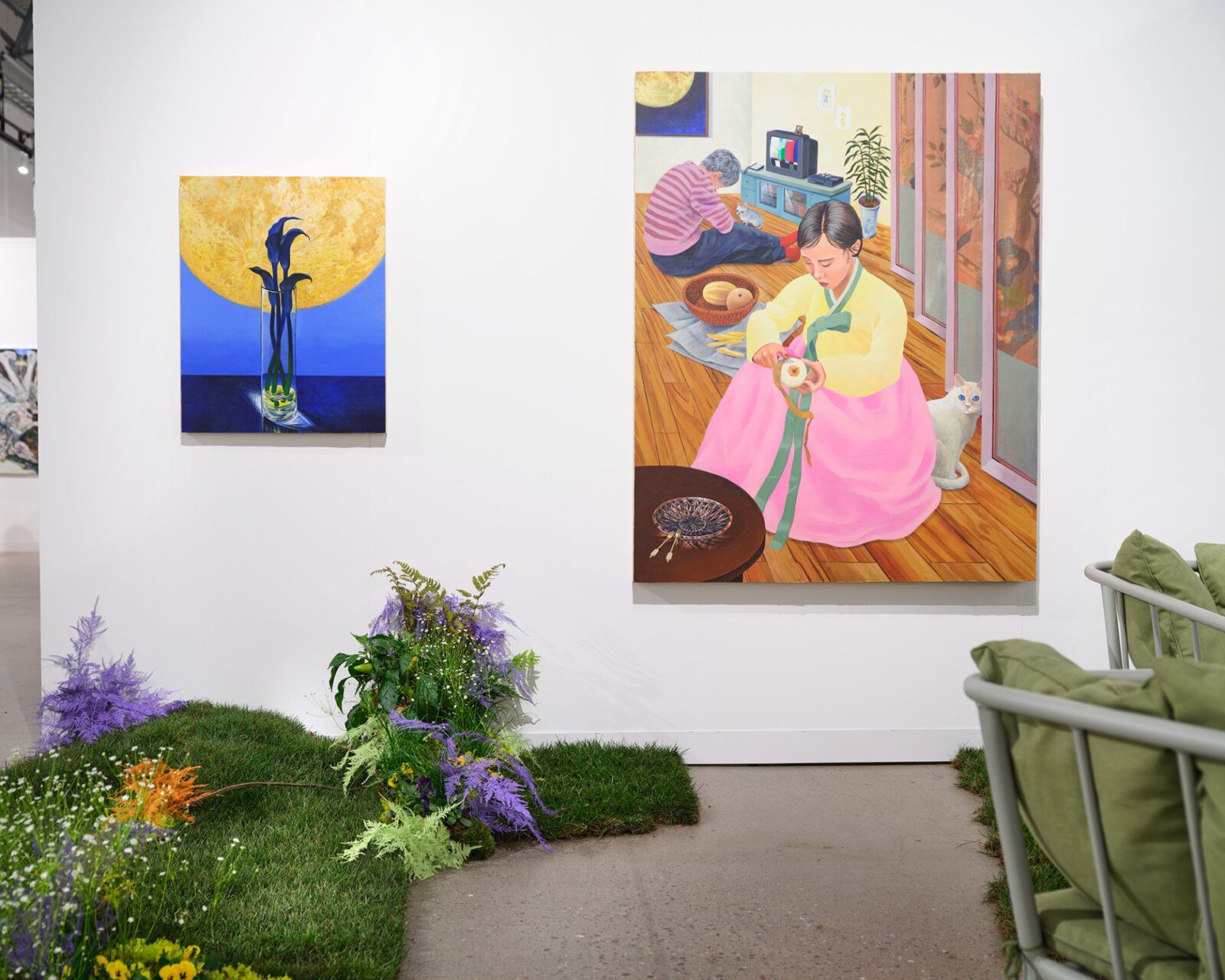
Stockholm-based Belenius (SE) offers a joyful thematic presentation titled The Great Spring Show, running in parallel with the Chelsea Flower Show in London. Having curated NYC-based painter Sally J. Han in a past show at the gallery, I admit some bias, but her figurative paintings with Chinese and Korean references are delightful and in strong dialogue with Isabella Ducrot’s collage works and the mixed media sculptures (and a video embedded in the grass!) of internationally renowned Swedish artist duo Hans Berg & Nathalie Djurberg, which draw on flora and fauna. As an unexpected twist, the gallery has invited floral designer and botanical artist Mirja Bozarth Fornell to add her green touch to the booth. Even before the fair, I had a strong sense that this would be a standout, if not the most talked-about booth at the fair.
Extending the current focus of its programme, Gerdman Gallery (SE), one of the more recent additions to the Stockholm art scene, presents two recent graduates from Malmö Art Academy (2025): painter Johnny Höglund, previously shown at the gallery, and sculptor Sigrid Soomus. The former presents a series of new paintings departing from an archive of found images sourced online and from social media, while the latter shows a new body of ambiguous metal sculptures alongside a resin-coloured latex installation. This is another accomplished two-person presentation, in which each artist amplifies the other, anchored in a soft-hard dichotomy.

Sigrid Soomus and Johnny Höglund, Gerdman Gallery, photo: Anja Karolina Furrer
Fredrik Værslev: this marks a comeback for the Norwegian artist, who emerged as part of a wave of male artists in the early 2010s but has been largely absent from the local art scene in recent years. He is presented at the fair twice; with bronze sculptures at Galleri Arnstedt (SE) as well as in a presentation by Carl Kostyál (SE/UK/HK), which juxtaposes paintings with tiled bathtubs and stands out as one of the stronger and unique presentations.
A gallery that has caught my attention via social media but that have yet to visit in person is Copenhagen-based palace enterprise (DK), presenting a group exhibition with Tora Schultz, Benedikte Bjerre, Marie Lund, Magnus Andersen, Young-jun Tak, and Simon Dybbroe Møller. The latter presents what may be the most captivating single work at the entire fair; an extreme close-up of an upward-gazing eye, flanked by Lund’s sharp-edged metal sculptures. At a fair where photography is largely absent this year, with only a few exceptions, this is a particularly welcome presence.

Marie Lund and Simon Dybbroe Møller, palace enterprise, photo: Jean-Baptiste Béranger
Where things get really exciting – and in sharp contrast to almost everything else – is Gallery Steinsland Berliner (SE), making a strong push for Arvida Byström, a unique presence on the local art scene. She presents an AI-generated video alongside glossy and racy sculptures evoking demi-human figures, partly produced using 3D printing technique. Credit to the gallery for being this bold, where many others have played it safe. One can only wish to be a fly on the wall of this booth, neatly wrapped with a pink ribbon.

So, how does this edition compare to past fairs?
Overall, very good. The level is generally high and more consistent than some in the past. As expected, there are also quite a few more mediocre booths that can be quickly digested, but there are certainly many highlights. Moving the fair to a new location is bold, but it has paid off, injecting fresh energy into this long-running event.
The real question, though, is whether Market will be able to retain, or even attract, new audiences beyond the initiated this weekend, given its more remote location and everything else happening this week.
Questions to some participants at the fair:
Katarina Sjögren, director and co-owner, Belenius, Stockholm
K.Z: The fair marks its 20th anniversary this year, and you’ve participated as a gallerist several times. Looking back, is there a particular highlight that stands out?
K.S: My strongest memory is from when I ran the gallery Crystal with Jun-Hi Wennergren Nordling. We created a special presentation with Åsa Jungnelius, who made an almost 10-metre-high obelisk specifically for the fair. At the time, the fair was held at Konstakademien in central Stockholm, in February. There was a snowstorm, and the transport company simply left the obelisque outside the building. We had to gather everyone we knew to carry this enormous phallic sculpture through the building. Looking back, it’s hilarious—though it certainly didn’t feel that way at the time. The presentation turned out beautifully, so it was worth it.

Sally J. Han, Mirja Bozarth Fornell and Isabella Ducrot, Belenius, photo: Viktor Sjödin
K.Z: Your presentation, The Great Spring Show, features a fun and unique collaboration, bringing together gallery artists such as Isabella Ducrot and Sally J. Han with Mirja Bozarth Fornell of BOZ ART. What were the ideas behind this concept?
K.S: We wanted to create something organic when the fair moved to a more traditional exhibition venue. The Chelsea Flower Show in London came to mind, particularly the similarities between art fairs and garden exhibitions—the strange temporality that contrasts with the perceived longevity of both gardens and art. I’ve been especially interested in gardens after reading Olivia Laing’s The Garden Against Time.
The starting point was to bring together artists from different generations and countries who engage with floral and garden themes. This includes Nathalie Djurberg and Hans Berg’s beautiful sculptures, Isabella Ducrot’s flower pots and floral textiles, and Sally J. Han’s painted floral arrangements in domestic settings. Mirja Bozarth Fornell has created a surrounding environment using real grass, flowers, and small hills—essentially a living, breathing space within the larger exhibition. We hope the booth will offer a calming, grounding experience where visitors can, quite literally, touch grass.
Aske Aagaard Andersen, founder and director, aaaa nordhavn, Copenhagen
K.Z: This is your second time participating in the fair—what made you decide on another solo presentation?
A.A.A: We chose to present a solo booth as a continuation of Albin Werle’s solo exhibition Ship of Fools at aaaa nordhavn in November 2025. This year’s presentation expands on the idea of interactive works.
We are showing both sculptures and paintings, each accompanied by instructions for use and play—including a work from Werle’s public installation The Magical Tunnel, an interactive piece created for the train station in Slagelse, Denmark.

Albin Werle, aaaa nordhavn, photo: Anja Karolina Furrer
K.Z: Copenhagen is currently booming with new gallery spaces and initiatives, to the extent that it’s difficult to keep up. How does it look from your perspective as a gallery director?
A.A.A: Copenhagen is an exciting place to be at the moment, with a growing number of new spaces and a strong cohort of younger galleries. At the same time, aaaa nordhavn is also an international gallery, representing artists from Portugal, Germany, France, and Sweden. We have also focused on art fairs outside Denmark, including Art-O-Rama in Marseille, and this year Market Art Fair, as well as Basel Social Club later in the year.
Sigrid Soomus, artist based in Malmö, exhibited by Gerdman Gallery, Stockholm
K.Z: Hi Sigrid, alongside some new metal sculptures, you are showing an installation in latex at the fair—a material you previously worked with for your degree show at Malmö Art Academy in 2025. What draws you to working with this particular medium?
S.S: Latex holds a duality; both submissive and resistant.
As a natural material, latex carries elasticity and durability, but also vulnerability. I’m drawn to that tension, working with it as a structure while exposing its fragile state. It feels as if it holds its own inner function and memory.
For me, latex is tied to the body. It gathers traces—air bubbles like pores, dust, hair.
I’m drawn to its sensual ambivalence: a surface that both protects and exposes, holds and yields at the same time. It’s this inbuilt tension, between endurance and dissolution, that I keep returning to.

K.Z: After the fair, what’s on the horizon for you?
S.S: After Market, I am participating in a group exhibition at Galleri Arnstedt in May. Beyond that, I’m excited to continue setting up my workshop and studio in Marieholm, outside Malmö.
Koshik Zaman is a contributor editor based in Stockholm, Sweden.