

Studio Tabac is a small artist-run space and studio collective focusing on contemporary photography in the suburb of Hökarängen in Stockholm, which has become an important local platform for the field.
“A place to play, experiment, and hang out with your friends, something equivalent to recording studios where we could come up with jams together,” says artist and co-founder Theo Elias.
As it is about to open the third edition of its salon, a group exhibition that this year gathers 81 artists and 97 artworks in a space measuring mere 12 m², and aims to offer a glimpse into where the medium stands today and where it might be heading next, I reached out to Elias, as well as two of the participating artists, Nicolás Wormull and Nadja Annika Katiza Brečević, with a few questions.
Theo Elias, artist and co-founder of Studio Tabac
K.Z: I know you are just in the process of opening Salong #3, so thanks for taking the time to chat.
What made you decide to start Studio Tabac together with fellow artist Angelica Elliott?
T.E: It all started back in 2022, when I decided to move back to Stockholm after almost ten years away, living in Berlin, Malmö, and Gothenburg. I felt the urge to settle down, travel less, and it was a time in my life when I felt the need to build a foundation, both in my artistic practice as well as on a personal level.
Having studied photojournalism at Nordens Folkskola and with an MFA in Photography from HDK-Valand, I have been in tune with the photography scene in Sweden for years. I have previously been involved in running artist-run spaces and studio collectives, both while living in Malmö and Gothenburg.
But when I returned to Stockholm, I felt that the city lacked those kinds of spaces. And there was actually no place that only showed lens-based art, which I feel can sometimes still be looked at as less valuable in the art scene.
I felt I wanted a place to call home, a place where experimentation and emotions in photography were the starting point, a place for people who approach photography the way I do. A place to play, experiment, and hang out with your friends, something equivalent to recording studios where we could come up with jams together, so to speak.
During my first summer back in Stockholm, I went to a lot of openings, but I also realized I didn’t know anyone in the art world. I knew a lot of people in the field in Malmö, Gothenburg, and Paris, but no one in Stockholm. So I had this idea, that if I didn’t know people in the art world, I would find a way to get them to know me.
At the time, I was also looking for a place to have a studio and a darkroom to be able to continue my artistic practice. The dream, I guess, was also to have a studio that could serve as a public art space. A space where I could invite friends and people that I was curious about to come and work together.
I wrote a post on social media where I said I was looking for a studio. And an old friend of mine, Angelica Elliott, reached out and asked if we should find a place together. Shortly after, we found an old tobacco store in the southern suburbs of Hökarängen, which fulfilled all the parameters we were looking for. After a few months of rebuilding the entire place, we were able to present the inaugural exhibition in January 2023. Since then, I have been the sole curator and have been running a quite ambitious photographic exhibition programme without any external funding. The way I see it, Studio Tabac is an extension of my own artistic practice, a visualisation of a medium, a process, and a state of mind. All boiled down into a small room in Hökarängen.

K.Z: Studio Tabac, as you mentioned, is located inside a former tobacco store. What else can you tell us about the set-up?
T.E: Angelica and I have been frequent visitors to Paris, especially to attend Paris Photo, which takes place every November. Every night in Paris, we always ended up at “tabacs”, these tobacco stores where you could drink cheap beers and buy cigarettes. When we got the place in Hökarängen, a former tobacco store situated on Tobaksvägen (Tobacco Road), the name for the studio was obvious.
People know the place for our exhibition programme, but the main thing with Studio Tabac is actually our studio and darkroom. This is where my daily artistic work takes place. One idea behind getting the place was finally to have a studio and a darkroom in the same space. It took me one year to rebuild everything, building the gallery space as well as the studio space and a darkroom from scratch. But it has paid off. Today we have a professionally equipped black-and-white and colour darkroom, as well as a studio space with different equipment and scanners necessary for working with analogue photography.


K.Z: You are just about to open the third edition of Salong Tabac, a salon-style group exhibition by way of an open call, which in its nature is very democratic. What has been the approach to this year’s selection, and what can visitors expect to see?
T.E: The first couple of years of running Studio Tabac, it was really important for me to turn it into a respectable place that offered well-curated exhibitions and a contemporary photography programme. What I felt was missing in the Stockholm art scene was a well-curated group show of and for photographers and artists working with the photographic medium. I also realised a group show was a good way to spread the word about our little studio. Goes without saying, the more artists involved, the greater the turnout.
An open call seemed like a good way to spread the word as well. After the first years of struggling financially with inflation, increased rent, and eventually burnout symptoms, I decided to invite more people to work at Tabac. I wanted to create a photographic community and share the rent, as well as the burden of the exhibition programme that I have been running on my own for three years.
This year, alongside myself, Angelica (Elliott), Milla Flyger, Hilma Hedin, Casia Bromberg, Linnea Wästfelt, Marcus Gustafsson, and a former member, Emilie Vesvre, have all been part of the process.
For this year’s edition, we have selected 81 artists and 97 works in total, a new record for us. It is also an ambitious exhibition to produce, given that the gallery space is only 12 square metres, but I am certain everything will fit in time for the opening.
Salong #3 will feature a diverse range of contemporary international photography, from intriguing collages in dreamy pastels and poetic stills of sloppy leftovers to forgotten moments from past family vacations and heavy snorting vehicles rushing through it all.
We are generally interested in people who want to push the medium further, beyond its original purpose of trying to capture reality. We have made a selection based on experimental, emotional, and fictional photographic qualities.


K.Z: Also, what might be coming up for you as an artist?
T.E: I just came back from Japan where I had a solo exhibition in February, which was an amazing experience. Now I am working towards an exhibition together with Copenhagen Photo Festival & Ex Nihilo in Copenhagen, as well as a group exhibition at Institut Suédois in Paris in the fall during Paris Photo. I am also preparing for a residency in Oslo in August at CYAN darkroom, organised by Nordic Analogue Network. Besides that, I am working on an autobiographical photobook, Poppy, that has been in the making for some years. Hopefully it will be released this year.
Nicolás Wormull, artist based between Valparaíso, Chile and Stockholm, Sweden
K.Z: What have you submitted for this year’s open call?
N.W: I’m exhibiting an image that was made in 2014 during a four-day residency in Valparaíso, Chile, at a small gallery. The city is dense and restless, full of smells, people, animals, and houses climbing steep hills between light and shadow. One afternoon, I went to Teatro Condell, a historic cinema that at the time showed adult films in the evenings but today only shows arthouse cinema. Between the bar and the screening room, there was a curtain you had to pass through to reach the theater. The curtain became important to me as a shift in space and tempo, between different layers of the city, between dream and reality, and between desire and distance.

Nadja Annika Katiza Brečević, artist based between Copenhagen, Denmark and Malmö, Sweden
K.Z: Having previously presented a solo exhibition at Studio Tabac in 2024, you are obviously very familiar with the space, and make part of its trajectory.
What will you be showing at this year’s edition of the salon?
N.B: Studio Tabac is a growing platform for photographers and an important space within Stockholm’s photographic art scene. I am grateful to have been involved from the beginning. Angelica and I previously shared a darkroom with several other photographers, and Theo was one of the first people I contacted when I moved to Gothenburg to study at Valand. Two years ago, I was invited to exhibit at Tabac, which resulted in the exhibition Jadrana. The exhibition included a series of hand-colored photographs, a video work, and a sound installation by composer Mike Sheridan. I have also exhibited in Studio Tabac’s annual salon in the past.
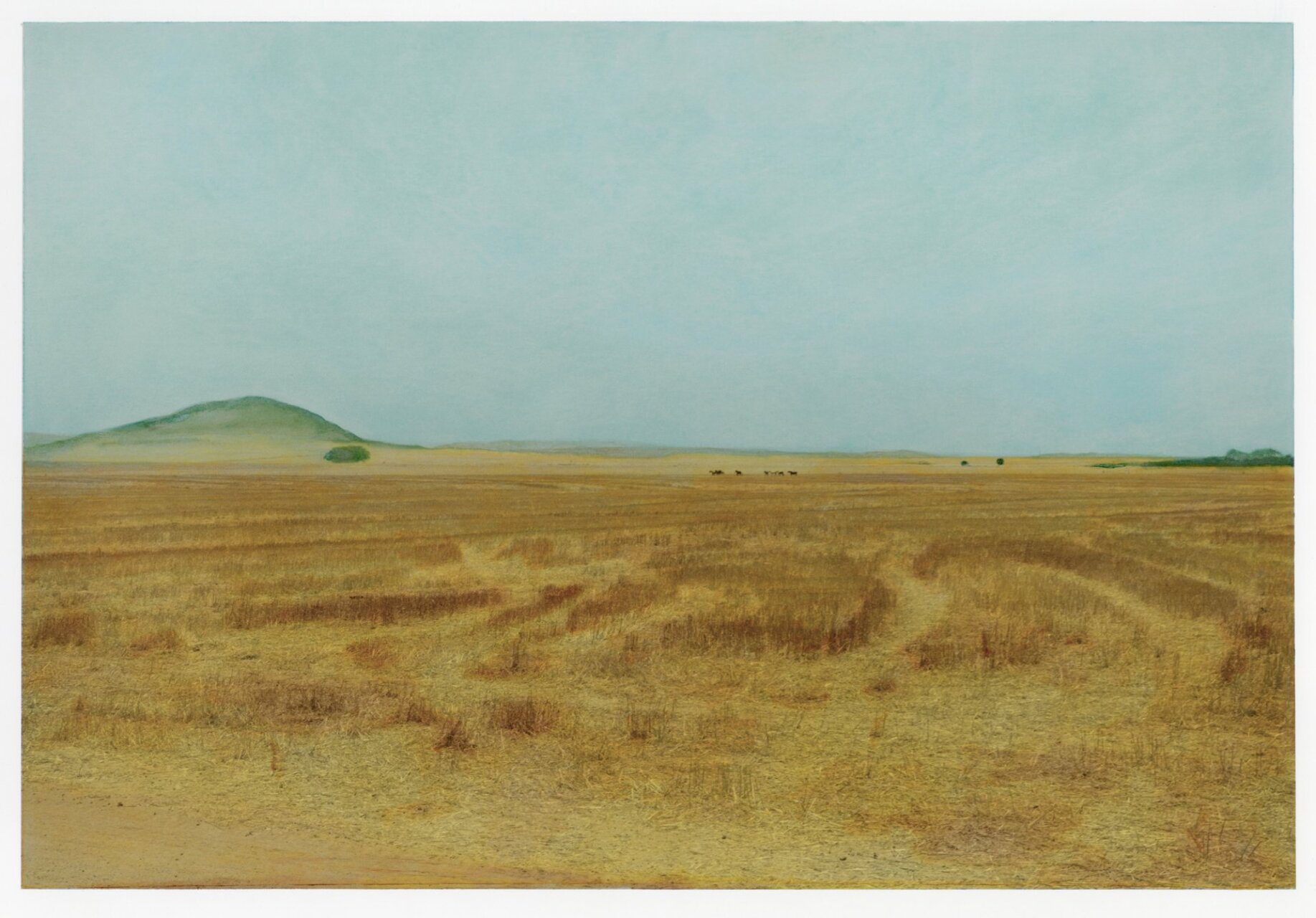
For this year’s salon, I am showing a photograph taken during a trip to South Africa earlier this year. The work is titled Distant Horses, and it is a landscape photograph. Like much of my ongoing work, this piece is also a hand-colored silver gelatin print. I appreciate the slow process of developing the image, spending time in the darkroom and finally coloring the black-and-white prints with oil paint. It becomes almost ritualistic, where I add colors based on a feeling or on how I remember the moment the photograph was taken. This particular work is part of a collection of landscape photographs from South Africa, though I have not yet had time to color the others.


Koshik Zaman is a freelance writer and independent curator based in Stockholm, Sweden. He has been a contributor editor to Daily Lazy since 2026.
Social media info:
@theoelias
@studiotabac
@nicolas_wormull
@nadjabrecevic
Images:
1. Salong #2, Studio Tabac, Stockholm, May 31 – June 14, 2025, photo: Theo Elias
2. Portrait of Theo Elias, photo: Simon Mlangeni-Berg
3-4. Salong #2, Studio Tabac, Stockholm, May 31 – June 14, 2025, photo: Theo Elias
5. David Padovan, Crash, 2024, pigment print
6. Hugo-Aldén, Värnhem chimney, 2026, C-print
7. Tilde Bergh Ängeby, Burberry Summer, collage
8. Nicolás Wormull, Teatro Condell, 2015, pigment print
9. Nadja Annika Katiza Brečević, Distant Horses, 2026, hand colored silver gelatin print
10-11. Salong #3, Studio Tabac, Stockholm, May 30 – June 13, 2026, photo: Theo Elias