

At the core of Norwegian visual artist Christian Tunge’s new exhibition, his third at QB Gallery in Oslo, is the United States of America. It draws from a body of work comprising more than two hundred images made across thirteen states over the course of eleven trips and eight years.
“I approached it more like a mosaic made up of fragments, observations, and different visual languages, making it an artistic project, not a documentary,” Tunge tells me.
K.Z: We first met in the summer of 2016, which makes it ten years ago. Time flies. Although our paths do not cross that often in person, I enjoy keeping track of your artistic whereabouts.
You are currently exhibiting a solo show, Falling Off a Horse Slowly, a project you told me has been eight years in the making and exudes “Americana”. Why the U.S.?
C.T: The project actually started shortly after we met. Trump had just been elected president, and I immediately knew that I wanted to make a “Trump photograph”. But I did not want it to be activist or over the top.
The idea I landed on was to travel to Mount Rushmore. Four white men have been carved into a mountain that belongs to the Lakota people as a photo opportunity for tourists. But I refused to make the image we have all seen before and instead made a series documenting the pine trees growing from the blasted rock left behind during the monument’s construction.
It started as a very conceptual work, but the day after photographing the site, I was caught in a spring blizzard. The airport and most mountain passes were closed, and I unexpectedly found myself on the road trip every European dreams about. I rented a car, and it took me through the small town of Brandt, South Dakota, where my great-grandfather emigrated in the early 1900s, and it became obvious to me that I wanted to make a larger project about the United States.


 K.Z: While I sadly will not have time of seeing it in person, you sent me a preview ahead of the opening. It is an eclectic body of work, amounting to more than two hundred images, including classic American iconography such as cowboys and elements of American pop culture, pro wrestling, for instance. Where across the U.S. were the images produced, and how did you decide on the final selection?
C.T: Yes, I have been working on this project for a long time. One of the reasons is quite simple: I have struggled with the idea that, as a Norwegian, I should come in and make a project that claims to say something overarching about American society.
That made me reluctant to show the work for a long time. I felt I needed to spend enough time in the country to at least complicate my own assumptions. The photographs were made across eleven trips through thirteen states over the last seven years.
This is also why the work became so broad. Rather than building a singular narrative, I approached it more like a mosaic made up of fragments, observations, and different visual languages, making it an artistic project, not a documentary.
This is the first time I have worked this closely with curators. I invited Mikaela Bruhn Aschim and Kari Kjøsnes at QB Gallery to help shape the exhibition. Since the archive is so large, the exhibition could have taken many different directions. Having three people edit the material together allowed us to see connections and possibilities that none of us would probably have arrived at alone.


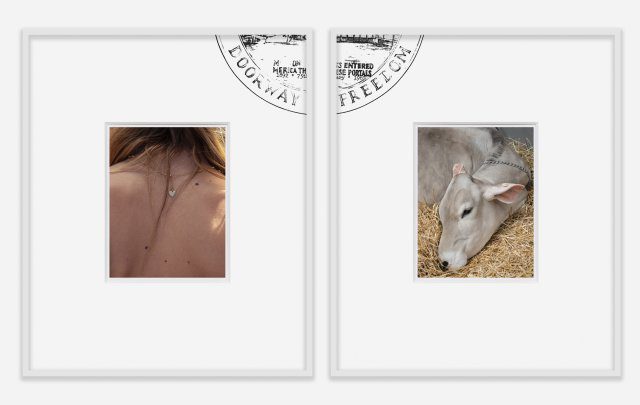
K.Z: You are very form-conscious. For the show, you have printed on the accompanying passe-partouts, a gesture I do not see very often. In some cases, the intervention is subtle, while in others, full images are juxtaposed with the framed image, creating new compositions. What were some of the ideas behind this?
C.T: I have always been interested in photography not just as an image, but as an object. Form, presentation, and framing become integrated parts of the work itself.
In this exhibition, the passe-partouts are large and the photographs quite small, partly because I wanted to emphasize that these are individual fragments rather than an overarching story about the United States.
The printed passe-partouts also allowed me to create smaller series within the exhibition, which is something I have brought with me from publishing. Graphic elements are printed across multiple works, creating connections between photographs that might otherwise be read separately.
I am interested in the tension between something as direct and controlled as a corporate logo, such as the Budweiser logo, and photographs that are much more open to interpretation.

K.Z: What is new with Heavy Books, the publishing house you founded while still at art school and through which several of your publications have been released?
C.T: Last year we published three beautiful books by Linn Pedersen, Kaja Leijon, and Morten Andenæs. We also have two new titles scheduled for release this autumn. I would also like to make this project into a book, but I do not want to publish it myself.
I still love making books, but it is impossible to ignore that the market is no longer responding in the way it did a few years ago. Inflation, high interest rates, and increasing production costs have made it, if possible, even more difficult to publish books. I notice it in my own library as well. I simply cannot acquire as many books as I once did.

K.Z: On a completely different note – as somebody who also enjoys combat sports – you are very proficient in BJJ. How is your practice coming along these days?
C.T: Over the last two years I have had two children, made two exhibitions and moved to the countryside, so lately I have been more of a fight fan than a practitioner.
That said, I have recently started grappling again, and the goal is still to become a black belt. I just have to add a couple of years to the original timeline.
K.Z: With the show now in its final weeks, what will you be up to this summer?
C.T: As I mentioned, my family and I have moved out of the city to Nesodden. It is a summer paradise.
Over the last few years, I have also become very interested in woodworking, and I have rebuilt half of my studio into a workshop. Hopefully, I will get some time to work on a few woodworking projects and continue working on the house and a backyard sauna.
Koshik Zaman is a freelance writer and independent curator based in Stockholm, Sweden. He has been a contributor editor to Daily Lazy since 2026.
All images courtesy of the artist/QB Gallery. Portrait by Jan Khür.
Christian Tunge’s solo exhibition Falling off a Horse Slowly runs until June 28, 2026 at QB Gallery, Oslo, Norway.
For more info om Tunge’s practice, please visit:
christiantunge.com
heavybooks.net
@christiantunge