


Once they were talking about dream interpretation on the radio. I called in and asked how it was possible that the things I dream about always come true.
Greeting visitors in the entrance stairwell of Longtermhandstand is a dedicated wall of mobile-phone photographs printed on simple A4 paper, installed with the same unfiltered, DIY flare that characterised Omara’s (1945–2020) self-fashioned environment in Szarvasgede. Together, they form a constellation of many selves: diva, artist, gypsy, woman, mother, provocateur, “naiv firkálgató”, activist and survivor. Across these images, as throughout her works in the exhibition Once they were talking about dream interpretation on the radio. I called in and asked how it was possible that the things I dream about always come true. at Longtermhandstand, self-representation becomes a form of protest with its own language, rooted in lived experience, personal relationships, dreams, achievements, humiliations and aspirations. Through painting, drawing, photography, video and miniature works, the comprehensive survey exhibition traces an elaborate and uncompromising act of self-mythology: part manifesto, part archival record, part refusal to be defined by anyone other than herself.
Omara began painting in 1988 at the age of forty-three, following the death of her mother. The serene, large-scale blue self-portrait This Day I Became A Painter… (1998–2002), installed downstairs, returns to this foundational moment. According to the artist’s own account, while suffering from a severe migraine, she asked her daughter to bring her paper and a pencil. She drew a portrait of actress Sophia Loren, who would remain a recurring figure in her imagination, and by the time the drawing was complete, her pain had eased. This first work, Sophi Loren (1988–), shown near the entrance to the exhibition, establishes the autobiographical, therapeutic and transformative role that art would assume throughout her life. Painting became an existential means of processing trauma, asserting identity and narrating a life shaped by humiliation, illness, poverty, racism, motherhood and survival. Crucially, it also became a way of recording her achievements and willing new possibilities into existence. A self-taught artist, she developed a radically direct visual language that fused figuration with handwritten text, autobiography with social critique, humour with rage, and tenderness with an often confrontational refusal of passivity or other people’s ownership over her narrative. As an element of this, handwritten inscriptions became one of the defining elements of her practice, starting from the early 1990s, as a way of ensuring that image and meaning could no longer be separated from her own voice. They record memories and crack jokes, recount dreams and personal encounters, issue demands, and confront both viewers and those responsible for the injustices experienced by her and the wider Roma community. Drawing on the visual languages of television, protest placards, tabloid headlines and everyday speech, Omara transformed painting into a form of direct communication.
Throughout Longtermhandstand’s two floors, intimate and poetic works are interspersed with overtly political ones, reflecting the way Omara herself lived with her paintings in her self-styled “luxury shack” in Szarvasgede. There, works documenting family memories, dreams, celebrity encounters, racial violence, political demands and personal achievements hung side by side, forming a dense and constantly expanding visual history. Her paintings return again and again to the conditions of her life – her daughter, her body, illness, poverty, discrimination, fame, anger, humour and pride – refusing any separation between private experience and public struggle.
The exhibition title is drawn from one of Omara’s quotes when she phoned into a radio programme about dream interpretation, to ask how it was possible that the things she dreamed always came true. This points to a kind of self-prophetic, or self-manifesting thread within her practice and way of life – her paintings didn’t just document her experience, but operated in a much more active and aspirational way, literally producing her desired identities, achievements and possibilities into being. Painting became not only a means of recording her life, but of actively shaping it. A constellation of such self-manifesting, aspirational paintings are included in the exhibition that transform personal milestones into public records.In the downstairs gallery, paintings such as You Went Through Three Moves When You Were Sick and You Did It Alone… (2009) and You Envied Me So I Looked In The Internet And Even Got a Trademark For My Name (2003) record episodes of resilience, ambition, humour and pride. The former celebrates the artist’s perseverance through illness, hardship and displacement before finally arriving at her self-styled “luxury shack” in Szarvasgede where she also established her own home-gallery all by herself. Omara famously took pride in achieving things alone, not waiting for anyone’s aid, pity or outside help, and her paintings often encourage fellow Roma people to “not be stupid” and do the same. The latter shows a smiling self-portrait against a blue background, overlaid with text recounting how Omara went online and trademarked her own name. Part boast, part message to her haters, the painting is a declaration of self-belief and ownership over her own story. In the lower corner, the phrase “of course I always take a cab” appears – a reference to one of the artist’s famous habits. Also included, the painting OMARA and the Venice Biennale (2007), was created in the context of her participation in the First Roma Pavilion at the 52nd Venice Biennale, commemorate moments of recognition that held significance for the artist.
Some of her most intimate works are installed on a dedicated wall in the upstairs gallery, as a part of her so-called ‘blue period’, or ‘blue paintings’, one of the most important, personal and recognisable bodies of work within her oeuvre. Initiated in 1997 following a dream about her daughter, the series emerged from a deeply personal association with the colour blue. In her autobiography, Omara recalls that blue had always been her daughter’s favourite colour: the colour of her best childhood dress, the colour she wanted for her room, and even the colour that mysteriously appeared in photographs they made together. Following a dream instructing her to paint a name-day gift for her daughter in blue, Omara began what would become an extensive cycle of works painted in luminous shades of blue and white. They are confessions, revolving around the artist’s most important personal experiences: her relationship with her daughter, the difficulties of motherhood, illness, poverty, racism and her experiences as a Roma woman. Motherhood emerges as one of the central threads throughout the series.
Omara painted almost 100 portraits of her daughter – such as Daughter Series pic. 9., (2006), included in the show – and repeatedly returned to moments from her life, who appears throughout the paintings as confidante, muse, companion and, in the artist’s own words, her “only diamond”. Several works are explicitly dedicated to her, with inscriptions stating that the paintings belong to her daughter. A particularly moving example is This Is Not for Sale, This Belongs to My Only One Too!… (2008), in which mother and daughter appear together in floating naked in a body of water, suspended between memory and dream.
Alongside these intimate works, the exhibition presents Omara’s explicitly political paintings, which address anti-Roma racism, police harassment, economic precarity, poor living conditions, housing inequality and institutional discrimination. These works are often raw, accusatory and direct. They refuse the expectation that painting should soften or aestheticise violence. Instead, they operate as acts of witness and public indictment. Several key works on view upstairs confront the racial violence directed at Roma communities in Hungary. God Damn You Racist Miser This Is A Message From Me… (2009) is a dark and forceful painting depicting groups of Roma people with crosses hovering ominously above them. Across the work, Omara writes a direct message of shame and accusation, addressing the killings of Roma people with characteristic moral clarity. Installed nearby, You Are Not Wrong. Who? Are You All? Murderers?… (2009) shows Omara herself bending down and exposing her bare buttocks in her iconic slip, the provocative image written over by white text “are you all murderers?? is this what you’re proud of? don’t you want a gas chamber too??”. Downstairs, Oh But I Do Pity You… (2014) addresses police violence and institutional mistreatment through a bright-green scene showing two police officers and Omara wrapped in a towel, her head lowered in disappointment. Two paintings displayed side by side in the cabinet by the upstairs gallery entrance illuminate Omara’s highly personal relationship to public life and political authority. My – Gypsy – God – Bless You !!!!!!!!!! If Heaven Exists You Will Be There! György Soros!!!… (2017) reflects her enduring gratitude towards George Soros. The work recalls one of the most legendary episodes of Omara’s career: after participating in the First Roma Pavilion in Venice, she presented Soros with her glass eye as a gesture of thanks. The gesture – simultaneously sincere, theatrical, humorous and provocative – became one of the most frequently recounted episodes of her artistic life and exemplifies her refusal to separate art from life. Installed alongside this piece, The Time Has Come – 2010 – Prime Minister!… (2010) addresses the newly elected Viktor Orbán. Depicting the politician with a broom, the painting calls on him to “clean out the mess” from Hungary, provide work for Roma communities and protect them from violence and exploitation. These two works installed together capture Omara’s willingness to address power directly, whether through gratitude, demand, criticism or confrontation. Other works, including Mara’s pensioner guest house (2010), deals with issues around housing inequality and community care. In this painting, Omara imagines transforming her own home into a free guest house for low-income Roma women, combining critique with a vision of practical solidarity.
Self-representation, through painting, photography, video and performance, was central to Omara’s practice. She documented herself in different roles and registers: artist, mother, fortune teller, diva, activist, celebrity and survivor. This performative dimension extended beyond the canvas into her public persona, television appearances (as a fortune teller) and self-staging. Her painted and photographic self-portraits and are equally charged with theatricality and political purpose. Downstairs, a triptych of black and white self-portrait photographs of Omara in Szarvasgede are on display, collaged with Omara’s iconic miniature paintings produced between 2010 and 2020. She made these on unconventional supports such as cigarette packets and matchbox lids. Omara described making these works at extraordinary speed – in tens, hundreds, eventually thousands – often beginning not with a plan but with a sudden craving to paint. The smallest work measures just one square centimetre.
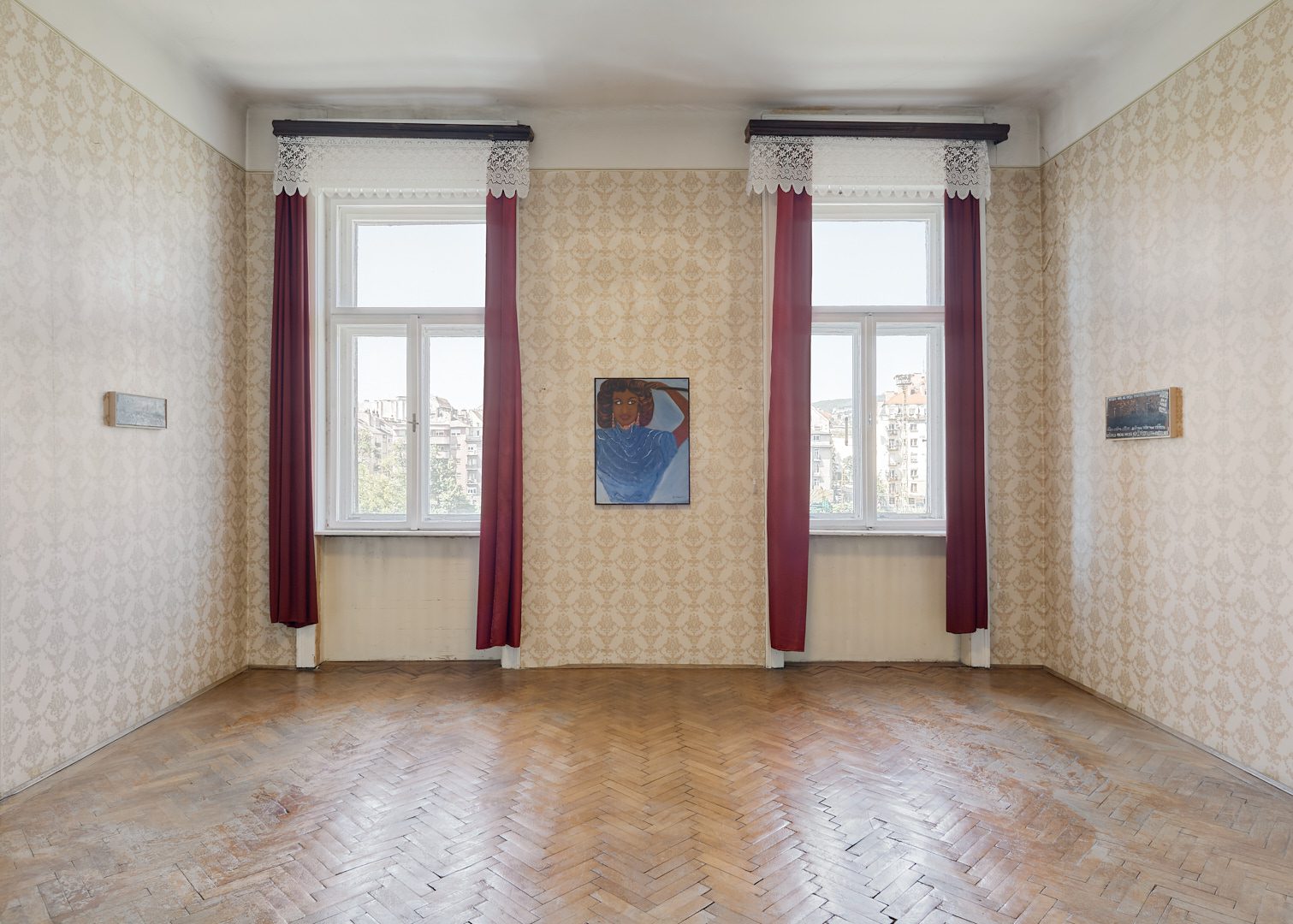
Upstairs, her striking blue portrait of herself as Sophia Loren from 1992 presents her with jewellery, styled hair and signature performative, self-conscious glamour. The painting She Doesn’t Want to See Anyone (2008–2010) shows her face hidden behind sunglasses, in diva-like withdrawal, and on the painting Great Woman (Nude), (1991 – 1993), hanging above the doorway in the downstairs gallery, she consciously inserts herself into one of art history’s most enduring pictorial traditions. If I Was So Ambitious, I Would Be A Banker… (2008), installed in the upstairs bathroom space above the sink, opposite the artist’s iconic white slip dress suspended above the bathtub. In this painting, Omara imagines herself relaxing in a jacuzzi in a luxury apartment if she had not chosen art, but become a banker instead – a funny, pointed and aspirational image that folds together fantasy, class critique and self-mythology.
A small room upstairs hosts one of Omara’s late works, I Will Educate You If You Don’t Know?… (2019), is shown alongside Ábel Sánta’s film Omara (2024). The painting, a deliberately crude and explicit image of two people having sex, was made in response to Hungary’s changing family-policy context and CSOK housing support laws. As with many of Omara’s late works, its apparent bluntness conceals a more complex reflection on morality, sexuality, state power, family structures and social judgement within the Roma community. Sánta’s film, interspersing interview material with images of artworks and photographs of the artist, functions as a kind of manifesto. In it, Omara reflects on her life, the judgements she faced both within her community and from the wider public, and the central force behind her painting:
“Had I not experienced so much humiliation, shaming, contempt and hatred, there would be none of the otherness in my paintings that makes them unique. With every work, I want to express emotions, tell stories, and wage a struggle for freedom against injustice.”
Ultimately, Omara refused to allow others to define who she was. Through painting, language, photography and performance, she constructed a world in which she could appear exactly as she wished to be seen. Her works move freely between confession and confrontation, humour and outrage, private memory and collective history. At once documents, performances, political interventions and acts of self-invention, they form one of the most distinctive and uncompromising artistic voices to emerge from postwar Hungary.
Text by Sonja Teszler