
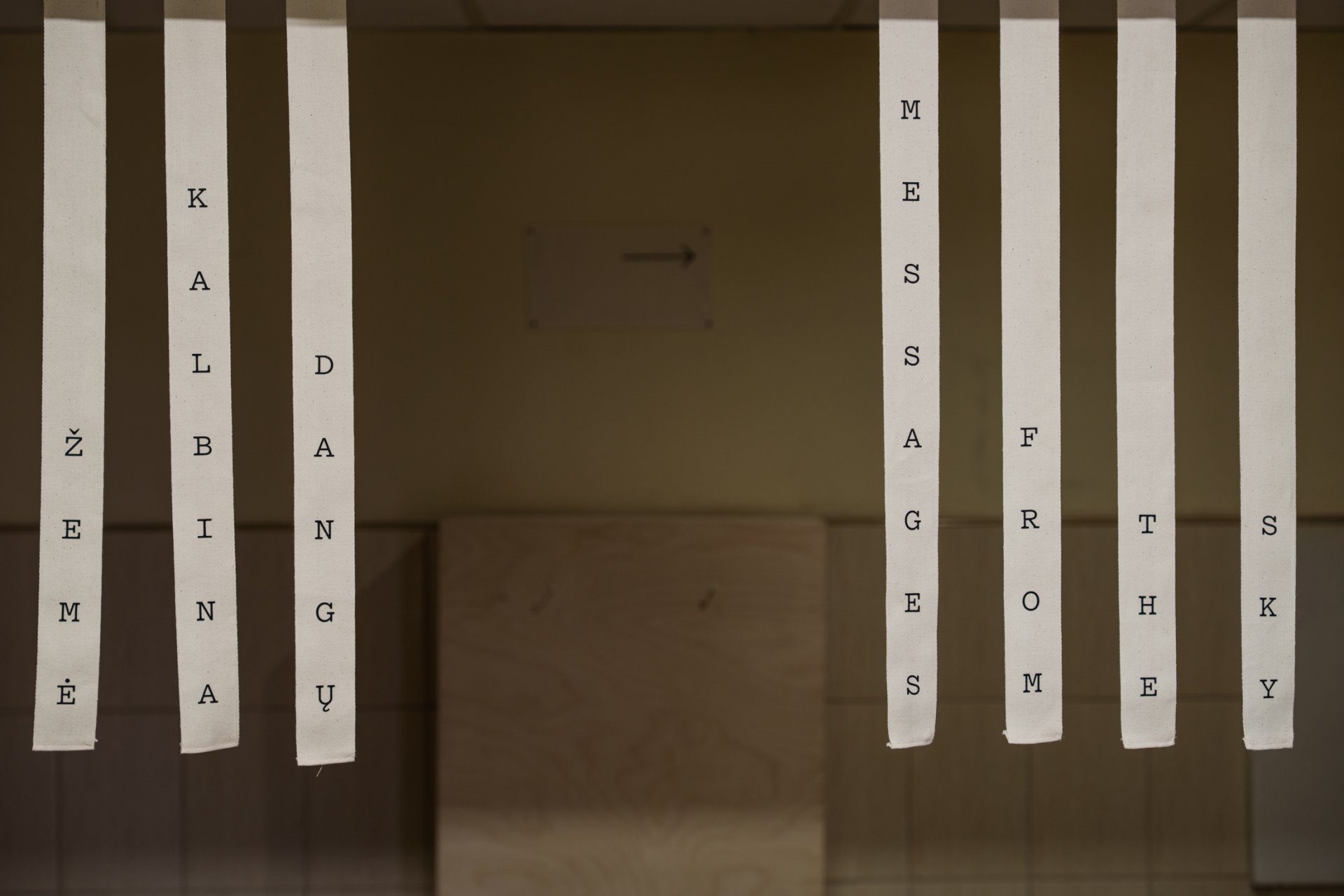


The exhibition brings together woven conversations and textile forms of address through which the artist reflects on intimate and time-consuming processes of communication. Jonynaitė draws on memories of those close to her and fragments of stories heard from afar, tracing shared experiences of the desire to connect and understand one another. Translating these narratives into sculptural and textile objects and installations, the artist explores communication across generations, ideological regimes, linguistic registers and time zones; between presence and absence, earth and sky.
—
It all began with a plough, a person leaning into it as if trying to inscribe their life into the earth. Later, as the
fl
a
k
e
s
of time and frost covered the fields, “Naktinės Personos” started singing about a letter written on snow. Now, sitting at my loom, I weave these stories across one another, following their crossings and piecing together a collage of fragments cut from different times, embellishing my own letter with emojis inherited from the past and invented for the present. I think about how attentively our ancestors once read the earth and sky instead of books. Today, the pages of the seasons and calendar leaves bearing gardeners’ advice are stirred by the breath of air conditioners – the North and West winds of a new generation.
The rebuses of these new clouds hold thousands of meanings. They change with the constellation of signs, with the thickness of the cloud. Perhaps this is why I have begun to avoid smiling in my messages. The true meaning of a smile now quivers somewhere between the upturned corners of the mouth. I am never quite sure whether it will reach you as I intended. Have you noticed how ordinary this state has become – this lingering uncertainty of being understood? I set a puff-cheeked little grass snake loose ~~~~~~~~~~~~~~~~~~~~~~~~:> Apparently, this is how hypocrites and traitors are encoded today. Yet, somewhat treacherously myself, I remain faithful to an older belief: that the grass snake living in the corners of the old house guards the home against fire, illness and evil spirits.
Reality is too intricate to be pressed into a single sign, and so I am left with a perpetual dilemma: how to end a letter – with a full stop or a comma? I often wonder whether stories that have been given a full stop stand a lesser chance of repeating themselves. Or whether commas, those tiny anchors of thought, weigh down my letters until they begin to sink. I have heard that the secret of the world is light – as light as a feather shed by a fluttering bird. What do you think: could this be the dialogue between earth and sky, this endless game of “Above the Ground”?
Without our eyes, without the endless astonishment of being human, the elements themselves would never suspect that they were speaking to one another. Just think of the arrogance of that. Perhaps the greatest error of our language is to imagine that the world speaks in the language and signs we have invented for it, to believe that the universe is answering us. Time and again I have found it indifferent to our presence – as indifferent as alphabets are to foreign letters wandering across their borders.
Can two letters grown in different gardens ever meet inside a single word? Look at these two, wandering far apart somewhere between language and algebra:
X
and
Ž
I watch them, large as berries, made of light, ripening along the curve of the palate, swollen with juices that refuse to mingle – just as oil will not mix with water. Wow, but did you know that an egg yolk can bind the two? Almost a tiny sun.
I do not know whether letters and words, emojis and inherited incantations, brought closer together, will draw us closer too; whether they will help us find a language in common. But I do know that sunlight and sound have the power to stitch time zones together. Not everyone knows how to read a musical score, but anyone can meet another person by turning towards the sun.
I switched to Eames Century Modern because, when building the house of my language, I care about the tiles that will cover its walls. The beauty of a letter can become proof of love; the weight of a letter can bring down a political system. The keys to my home jingle, reminding me that history is guided not by the voice, but by the ear. Think how simple the truth is: our communication depends on how closely you listen to me, and whether I can hear you.
And so we piece our stories together, suspended between the gravitational pulls of two worlds. Language holds us by the feet, silence by the shoulders. In this tug-of-war over our bodies and the memory harboured within them, time wins. Everything happens so quickly that I lose my sense of time. It feels as though we spoke the day before yesterday, though your last message arrived a couple of weeks ago.
Do you have time to meet? I want to show you something.
—
Morta Jonynaitė (b. 1995) is a Lithuanian artist living and working in Vilnius. Exploring the environment through tactility, the artist tries to grasp surrounding phenomena, relationships and states using traditional textile techniques. Hand weaving and net knotting are archaic crafts with a clear structure, which she employs to weave stories that capture the present. Presenting her work in the form of installation, Jonynaitė constructs intimate spaces where relationships between different experiences and participants are interconnected. Jonynaitė graduated from Gerrit Rietveld Academie (NL), where she studied in the TxT (text, theory, textile) department. She actively participates in exhibitions in Lithuania and abroad. “Messages from the Sky” is the artist’s fifth solo show.