


The exhibition is realised with the financial support of the “Singer-Zahariev” Foundation.
Hinge points extend beyond the concept of pivoting. Rather than emphasizing tension, division, or linearity, they compel trajectories to intertwine, relate, and participate in a broader dialogue.
By juxtaposing multi-layered narratives from seven Romanian artists, the exhibition highlights subtle parallels among object structure, linear geometry, decision-making processes, and fragile breakpoints within society.
Rather than grouping specific narratives under pressure, the exhibition seeks to alter pieces and ideas that originate from diverse backgrounds. Its objective is to foster a state of balance that has been absent in recent years within Romanian society, establishing a space of equilibrium amid unpredictability, connection, and continuity. This composure is intended to reveal a new form sustained by multiple hinge points.
The exhibition invites viewers to engage with a nuanced layer of society, characterized by continual shifts along multiple axes: from past to future, from left to right, and from interior to exterior environments.
-Roxana Morar
Vlad Albu
Holder for Round Objects 10, walnut, beech, birch, agate, 2025
Holder for intervals 1, mineral composite, quartz sand, alpha gypsum, 2025
Holders is an ongoing series that explores the ontology of objects and their capacity to act, form relations, and produce effects beyond human intentions. The artist is interested in their existence beyond utility and the practical functions we assign to them, as well as the relational power that emerges when objects come together.
Holder for round objects focuses on fragile moments of balance in which a fall seems imminent. The structures that sustain these situations offer protection while remaining imperfect and vulnerable to failure. The viewer’s presence becomes implicated in this uncertainty, bringing an awareness of their own movement and a sense of responsibility toward the objects’ precarious equilibrium. These encounters open onto broader ethical and political questions about how we support one another, how much we value care, and how we participate in sustaining or destabilizing the systems we inhabit.
Holder for intervals explores space as a condition through which objects coexist and affect one another. The artist is interested in / The work explores the interval as a place where the presence of one thing changes the possibilities of another where their limits and capacities become involved in each other’s existence. To hold an interval is to sustain the space through which this encounter remains possible. Separation becomes part of the work of support, allowing things to enter into a relation while retaining a presence that exceeds their role within it. The interval gives material form to this negotiation between connection and difference. Within Holders, it opens a question about interdependence: how things can sustain one another while leaving room for what each might become.
Andrei Arion
Protecting Your Dominant Hand Is Important, aluminum and stainless steel screws, 2026
Supporting Your Dominant Hand Is Important, aluminum and stainless steel screws, 2026
Protecting Your Dominant Hand Is Important and Supporting Your Dominant Hand Is Important are two sculptures that explore the possibility of creating objects whose function belongs more to an imagined reality than to the physical world. Both take the crutch as their starting point, borrowing its relationship to the wounded body and its promise of stability, while gradually moving away from what makes it useful. The sharp, elongated structures recall blades, spears, and other objects associated with defence, giving the sculptures an ambiguous character somewhere between protective equipment and weaponry. Although they appear capable of performing a task, their construction makes them impractical, if not entirely impossible to use. Their functionality depends on the rules of a science fiction film or video game, where an object’s purpose is often communicated through its appearance rather than its actual ability to work.
The two sculptures are designed specifically for Arion’s own proportions, as extensions of his body rather than universal objects intended for anyone to use. At their centre is the dominant hand, perhaps the most important instrument in the artist’s studio, responsible for translating an intention into a physical object. There is something almost ritualistic in the idea of constructing an elaborate device to preserve a part of the body that is already capable of performing its task. At the same time, the sculptures raise the question of how far an object can depart from its intended function before it becomes something else entirely and people question its form and use. Their titles read almost like practical advice, yet the objects themselves offer no clear instructions.
Albert Kaan
Undecided Monument, stainless steel, marble, 2026
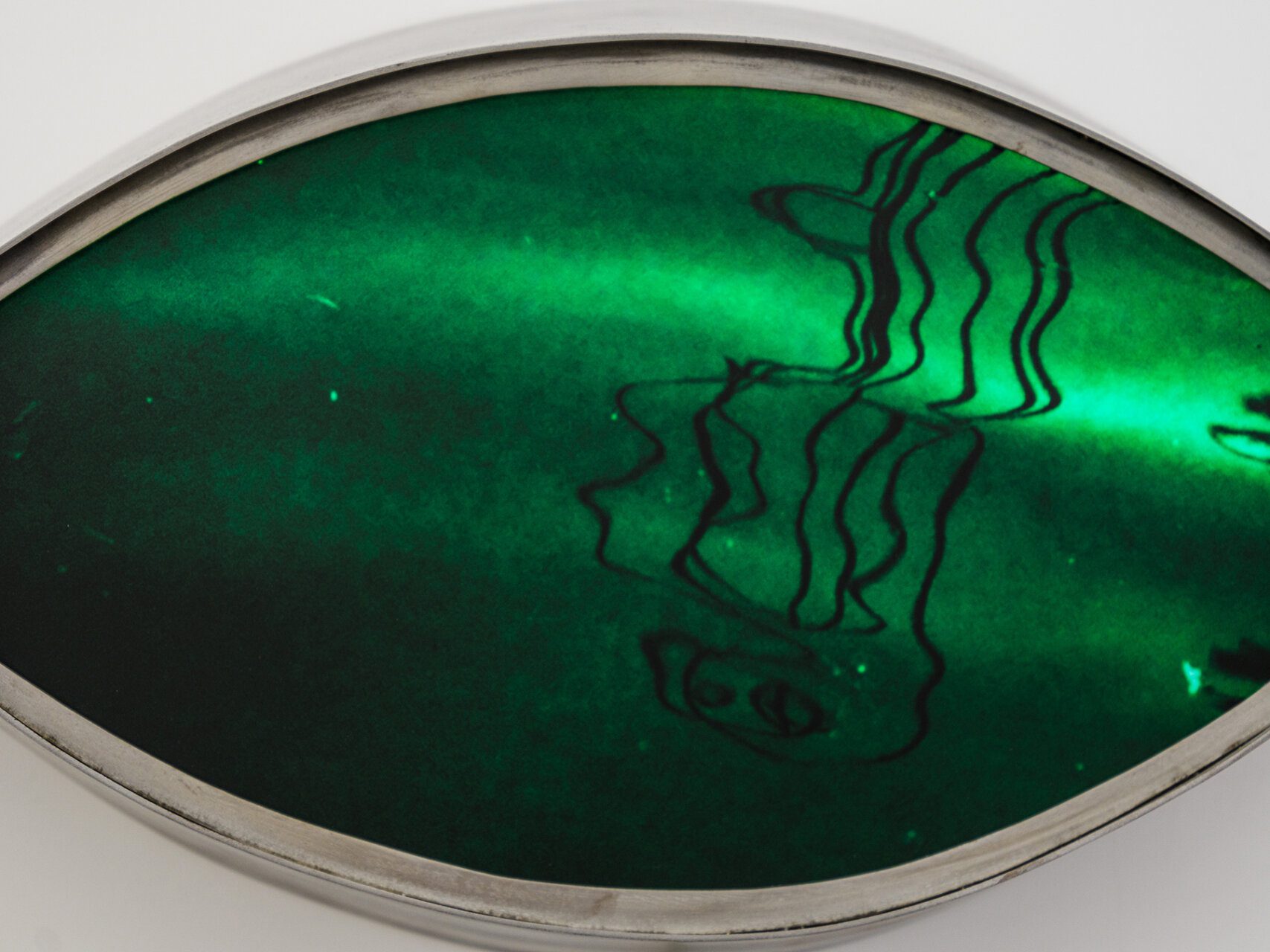
(Nothing looks the same), lightbox, 2026
Undecided Monument explores identity through the layering of multiple outlines. Instead of a solitary figure, the work superimposes multiple, distinct outlines, none of which becomes the definitive image.
The work starts from the idea that identity is not fixed, but shaped by the accumulation of different versions over time. Every experience, choice, and change adds another layer. The self is not a single image, but the sum of overlapping identities.
The work also questions the idea of a finite, self-contained form. The outlines have no clear beginning or end, and no defined middle. What is visible is only a segment of a larger structure, as if the work continues beyond its physical limits. Rather than presenting a complete image, it occupies a point within a process that has no clear endpoint.
Undecided Monument proposes a different kind of monument, one that does not commemorate a specific person or moment, but the ongoing and unfinished formation of identity.
(Nothing looks the same)
The lightbox reinterprets the sculpture’s overlapping outlines through their reflection in water. Distorted by the movement of the surface, the original forms remain partially recognizable while merging into a new, fluid configuration. The image shifts the work from the accumulation of identities towards their ongoing transformation, where the original form becomes a starting point rather than a fixed image.
Andreea Ilie
Tsentr Mass, metal, 2026
Tsentr Mass reimagines the playground swing as a structure where the aesthetics of Soviet childhood intersect with the visual language of state ideology. Its seat, shaped as a red star, transforms a familiar apparatus of play into a symbolic object, embedding political iconography within the everyday environment of the child. In Soviet pedagogical thought, childhood was understood as a formative stage in the construction of the “New Soviet Man,” with play being a means of shaping behaviour, spatial perception and collective identity. Playground structures were therefore, beyond functional objects, a translation of technological optimism of the Space Race and the ideals of collectivism into physical experience. By merging the swing with one of the most recognisable symbols of Soviet power, Tsentr Mass looks into how ideology becomes part of objects encountered through everyday use, dimming the boundary between play and political formation.
Dumitrița Răzlog
They See Me, photographic print on transparency film, mirrors, wood panel, 2025
A photographic object composed of mirrors mounted on a panel and layered with transparent prints of scanned Polaroid fragments, enlarged until the analog image dissolves into pixels. Based on a collage of Polaroids taken in Bucharest, the work explores the transition from analog image flow to digital information. Through scanning, enlargement, and fragmentation, the image loses its original continuity, as details collapse into abstraction and the city breaks down into unstable visual fragments. The mirrors introduce a reflective surface where the viewer and the surrounding space appear as a diffuse flow, interwoven with the pixels. The work reflects on the post-internet condition, where images shift between physical presence and digital information, and where the boundary between continuous visual experience and fragmented data becomes increasingly unstable.
Delia Prodan
Venus is the evening star, is the morning star
2025, sound installation
Venus is the first celestial body to emerge in the evening and, at another time of the year, the last to remain at dawn, oscillating between two instances of time and geographical coordinates. In Romanian, this star takes on masculine valences and is called Luceafărul, which, in the Romantic period, became the subject of a poem that grew into one of the most important pieces of Romanian literature. In the poem, the female figure is cast as inconstant, fickle, while the masculine presence is held up as the archetype of the genius.
Here, the work seeks a complete abstraction, an almost assured use of language that obstructs a culture which has become canon, flattened. It is a simple enumeration, in alphabetical order, using the English translation that has been referred to most. One voice echoes the other, delayed, like a translation of its original.
There is a bird and a stone in your body p. 116
2026, grey jasper, 5 cm each, installation dimensions variable
Approximately one hundred small, identical forms lie scattered in various corners on the ground: stone eggs, dispersed into the space in an unassuming manner, with no hierarchy or nest as a center, their origin abstracted away, as if one had stumbled onto an odd treasure hunt.
Each egg is a possibility, a site or a conglomerate paused in a state of potential, becoming, in terms of scale, a kind of miniature reminiscent of a twentieth-century sculptural vocabulary, employed here through repetition.
various translations of an eagle
2026, metal, C-print on alucobond
An architectural model photographed from different perspectives: without knowledge of the location, the place becomes abstract; it could be a military map or an unknown settlement. In reality, it is an astronomical observatory, built during the Cold War.
Even at this scale, a brutalist presence can be intuited. The metal plates seem caught in an unknown act of folding or unfolding, so the structure is either waiting to be discovered or about to be closed. Seen in this movement, the form of a coat of arms begins to emerge.
Sergiu Ujvarosi
WET DOG, plaster, wax, aluminum, 2026
A word that evokes a physical form, a scent, a visual or tactile sensation.
It comes from the image of a dog, Rex[1], present in the plaster bas-relief, emerging from the river like an amorphous body. In this series, there are levels of volumes and levels of images.
The works fluctuate back and forth, arranged around the space with no established order. Weaving through found and archived items (bones, animal images), making links and finding connections. The attempt, through the weaving of image and volume, is to evoke, or awaken, a sense of the concrete; to speak about the distance we might have from the condition of being a body, being matter, fluctuating and being part of a whole. All these works will eventually be recycled, melted down in future trials, along with their supports, returning to their base matter and sharing the same status. No end is finite.
The frontal view relates to gargoyles: a direct, face-to-face confrontation, reminding us of the mortal nature of the body when faced with danger. Inspired by a passage in Baptiste Morizot’s book Sur la piste animale, in which he describes a frontal encounter with a wolf.
The work evokes the integration into an environment that shapes us, while we shape it at the same time. The channels are necessary for the forms to exist, just as an environment is necessary for a form to take shape.
A fading image is still a body. A bas-relief exists somewhere between body and image, not fully one nor the other. A wax form, a transitional and ephemeral state.
[1] Rex is the dog of the artist’s father, which now lives in France