





At the end of the summer holidays, we sat indoors on the sofa, trying to stay cool. We watched a movie on an early flat-screen, a scene of a theatre curtain rising I believe, pausing it to go and play outside. Upon returning, an after-image of the scene remained, scorched into the pixels – persisting even when the TV was unplugged and the DVD player switched off. An overlay left to interrupt other images across the channels.
Our vision is endlessly polluted by objects, themselves marked by interruptions across their surfaces. Like any instrument, our eyes are capable of faulty readings. Part of the machine misfires, resulting in a loss of focus. Minuscule things float between us and the world – light or dust or debris. If a subject goes out of focus while taking a photograph, these marginal elements are foregrounded, complicating what is seen, captured and remembered. When editing such an image digitally, we may work on a transparent layer placed above the original – a sacrificial surface to shield whatever lies beneath it, while protecting us from the consequences of our past decisions.
Just over a decade ago, a replica of Pharaoh Tutankhamun’s Tomb was opened to the public, about a mile from the original burial site. The millimetre-accurate double, fabricated using thousands of tiny reference images generated by 3D-scanning technology, reconstitutes every detail down to the microscopic fungal spores on the walls. At the level of human perception, both tombs are identical. But the second site is an inferior surrogate, designed to draw footfall to protect the first. The sites will never be equal, because, though functionally similar – in celebrating a history – the replica can only ever be seen as an attempt to reconstitute its original. It is irresolvable – an attempt itself a condition of endless becoming – especially when its intentions are made to differ from that of the thing it is doubling. For this reason, perhaps resolution should not be an intention for the replica.
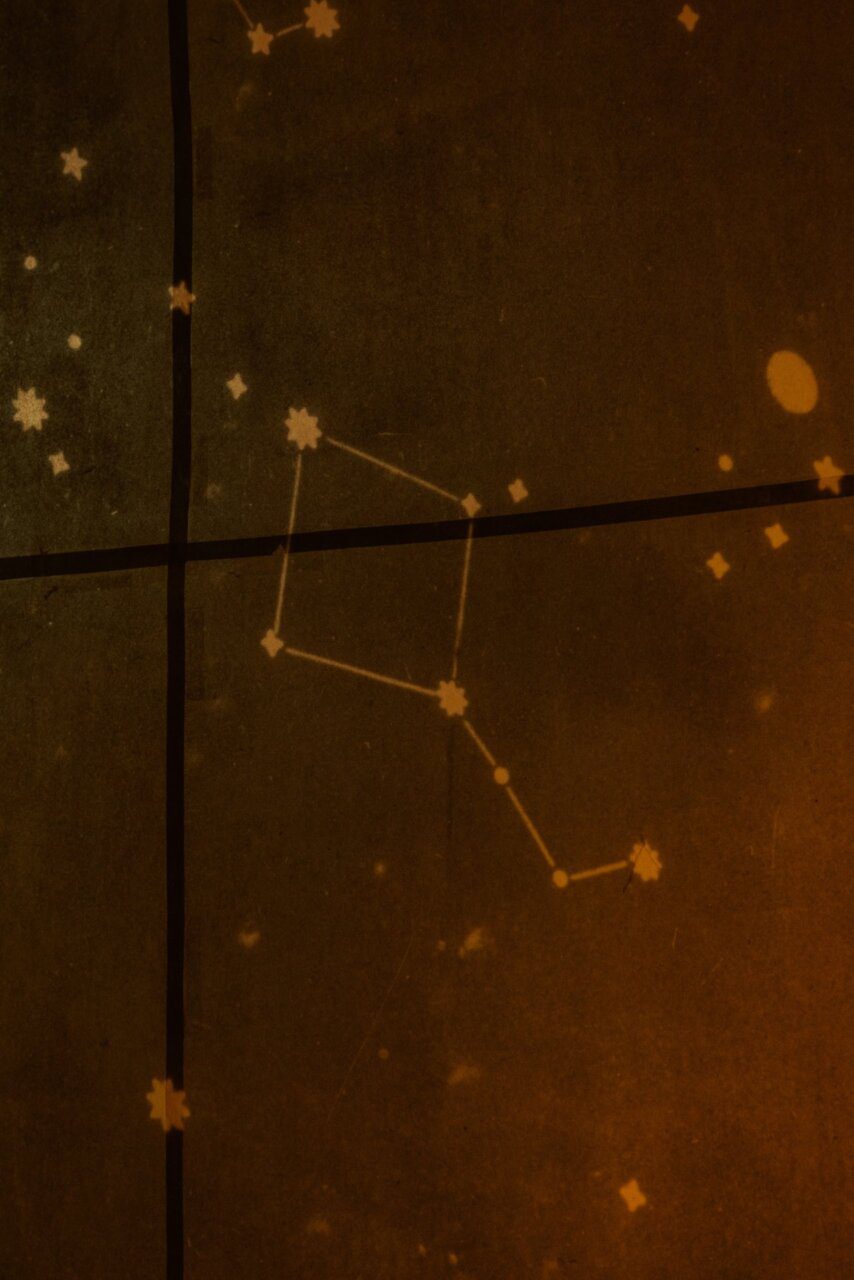
It has been said that our visual limits lie not in what is visible, but in our brain’s ability to project beyond what we already understand. When we define something with language, its mess is controlled through the flattening of complication. And when we describe something, it is impossible to denote each element precisely enough to give a realistic idea of the thing itself. Take the drastic changes in scale between the galactic, the domestic and the molecular. We can visualise planets or atoms, have read about their behaviour, and have an idea of their scale against other recognisable structures, yet our understanding of them as visible substances remains elusive. They are comprehensible through language, which fails to describe them accurately, instead taming them into symbols – diagrammatic stand-ins that we can digest and understand.
The Overview Effect is commonly experienced by astronauts while viewing the Earth from space. The occurrence takes place in the presence of particularly beautiful stimuli, and is capable of altering our individual value systems – how we view ourselves. As a sensation, it has been described to be “beyond words”. Here, language fails the image and its experiential excessiveness; its unruly indescribability. Where language succeeds in constituting the symbolic, it remains unable to accurately capture the sensations of the visual at its extremities. More accurately, our visual limits lie not in what is visible, but in our brain’s power to abstract.
Yet sometimes, the mundane becomes abstract too. We see things through a gradual exposure, pulled slowly into focus by the world’s framing devices. If we lose an object, it becomes transformed, suddenly crystallised by the mind, having never felt so detailed and important. We notice a difference in our surroundings – something has clearly changed, but we’re not sure what. We might see an object so many times on a stroll, or during a lunch break, or in a local supermarket near work or home, that it becomes camouflaged, its environment suddenly co-opted to prevent it from becoming noticeable. It takes a powerful shift to pierce the cloak – to return these elements to visibility. By removing their surroundings, the camouflage fails, positing that these objects are unintentionally overlooked, and therefore may be of an order that quietly structures the
social fabric of daily life.
A series of unresolvable complications between an object, its abstracted surface and the interruptive layers between it and our eyes, the replica occupies a space somewhere between language and image. Each illusive element traces the questions posed by its original, unable to fully answer them, instead relying upon convolution as the defining characteristic of its existence. Just as the replica tomb exists as a version of an original, its function as a real, experiential thing denotes that truth can only ever be a version of itself, too. Looking forwards, perhaps these complicated forms should not be neglected, but embraced. After all, our vision is endlessly polluted by objects, through which the past shines.
Returning home from school one evening a few weeks later, the damaged TV had been replaced with an identical model. Not only did we already know it – the contours of its buttons, its nuances and flaws – but we liked that it reminded us so well of the old one, and the experiences we had while watching it, too.
.
Amateur Doubles is kindly supported by The Henry Moore Foundation, and The Elephant Trust