
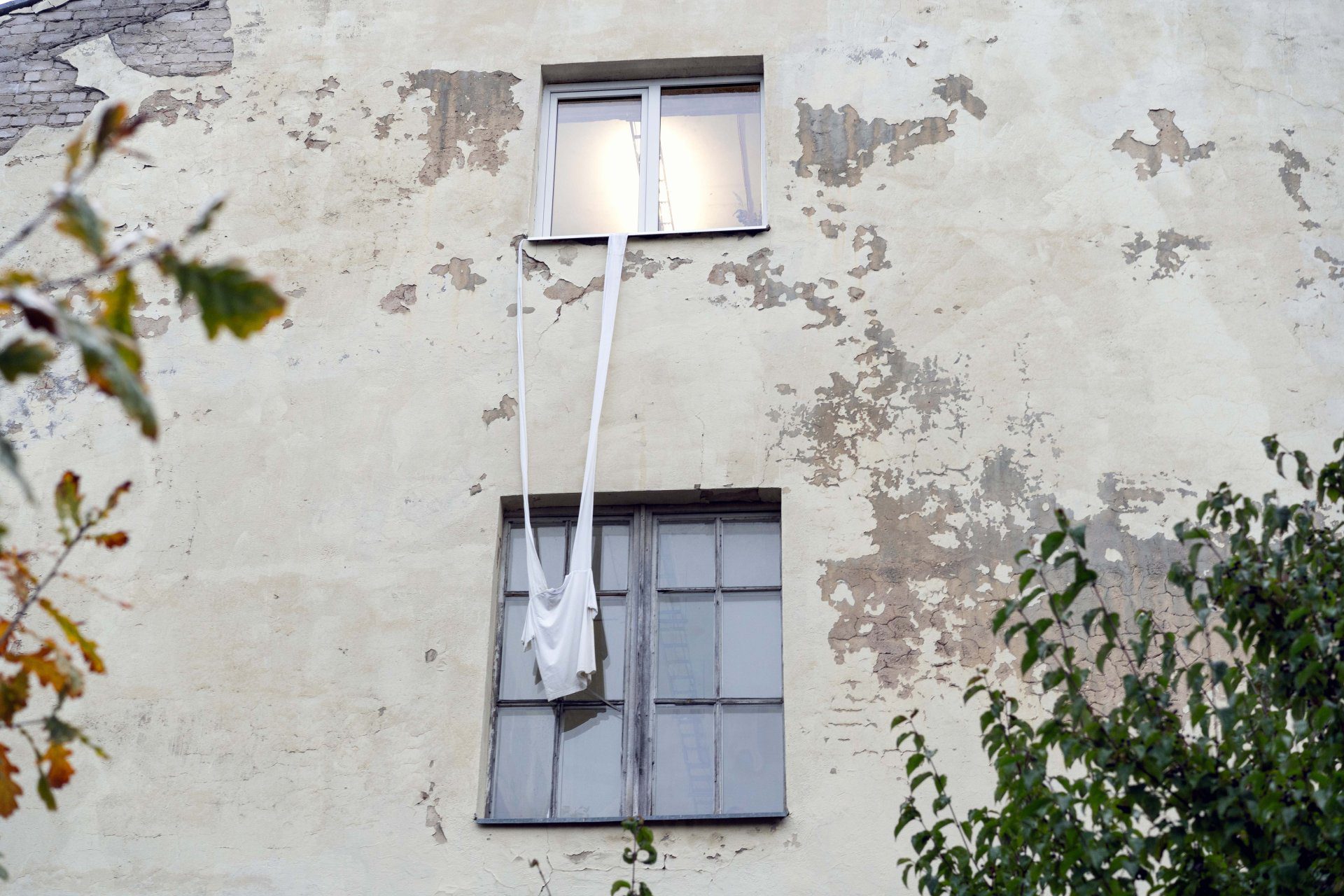


I met MM outside the academy for the first time here, at the “Swallow” project space. I greeted her with a tinge of unease; like her, I had come here alone. I waited, thinking the question would slip by. MM was doing what I thought made sense to do—she was writing exhibition reviews.
Years passed; the swallow finished its song, MM earned her degree, and I was still standing in the same spot, wandering the route between Alytus and Vilnius. MM and I led tours at the Baltic Triennial exhibition, which had become a forge for flowing narratives.
It was Advent; MM told me, and I told MM, about things we’d dreamt and lived through. Our conversation included a story from one of us—I don’t remember whose, but probably not mine—yet it felt as real as my own. Again, I remember the dream as if it were my own, but let’s imagine that MM and I were there together.
“The director of the institution included a very expensive exhibition in the program. That same director curated the exhibition, and as we would later realize, he reimagined the exhibition we had already come to know so well during our tours. The layout and spatial capacity are the same, only here, the exhibition objects were packaged. Mother-of-pearl paper, bound with pink thread—only wires and connectors are visible. Aside from the scale, a few works stand out with labels reading “fragile.” We happened to arrive just as the photographer was documenting the works, but the resulting photos would not have met with the artist’s approval (the works were presented improperly). The exhibition text is the same as in the previous one, except that in this case, the artists are distributing their own alternative versions(and another participant’s) biographical accounts are mixed up, and their cities of residence are confused. The director set up the exhibition; only he and a critic—who had consumed hard drugs—attended the opening, and the critic described the experience in the accompanying review. “…” The only way to get started in a career is through friends, isn’t it? (NR),” the review is full of general observations, and the exhibition is described as “self-creation.”
We don’t reflect too much with MM; she simply warns me that these ideas have probably already been used, and if we wanted to curate the Venice Biennale, we’d better start preparing right away.
_____
The exhibition “Wayword” is a field in which birds appear as metonymies of promise, memory and change. New works created specifically for the exhibition remain in a state of flux here, almost unfinished, and as the roles of the participants overlap, the exhibition itself constantly dismantles and reconfigures itself; the neologism “Wayword” describes this process as a deviation of word and direction. Words, sparrows, waywords… a world suspended on its own tropes, beheading a chimera at the ends of Baroque furniture.